TL;DR for Engineering Leaders
- Vibe coding needs governance frameworks, more than hype-driven adoption or blanket bans.
- Production deployment requires explicit security, testing, and observability gates.
- Controlled autonomy AI freedom with deliberate constraints.
- Strategic talent advantage is shifting toward constraint architecture skills.
- 40–60% faster time-to-market is achievable with proper implementation and governance.
As Chief AI Officer at Trellissoft and an advisor to teams scaling AI-assisted development, I’ve watched vibe coding evolve from novelty to a legitimate development methodology.
Whether you call it vibe coding, AI pair programming, or AI-assisted development with popular AI coding tools like Claude, Cursor, and GitHub Copilot, the velocity gains are real—teams shipping in days what previously took weeks.
But so are the risks when organizations scale without guardrails.
At this point, the real question isn’t whether to adopt vibe coding. Your teams are already using these tools. The real question is:
How do you capture the productivity benefits while protecting the reliability and security your business depends on?
The answer lies in what I call controlled autonomy—giving AI-assisted development enough freedom to unlock innovation, and enough constraints to keep you within enterprise-grade reliability and compliance.
Let’s dismantle five myths that quietly undermine that balance.
Myth 1: AI Code Generation Eliminates the Need for Technical Expertise
The misconception:
“If AI can generate code from natural language prompts, technical depth matters less. Junior developers can now do senior work.”
Why it persists:
Demos look magical. Landing pages built in hours, MVPs shipped by non-technical founders. The barrier to starting has dropped.
The reality:
Vibe coding doesn’t replace technical judgment—it amplifies it. The gap between “it runs on my laptop” and “this is a production-grade system” has not gone away.
In my work helping enterprises deploy AI automation, one pattern is consistent: Teams with strong architectural fundamentals extract 3–5x more value from AI assistance than those treating it as a shortcut for expertise.
Effective AI-assisted development requires engineers who can:
- Design prompts as systems: Translate business requirements into precise AI constraints—this is prompt engineering for developers becoming a critical skill alongside traditional architecture.
- Evaluate outputs critically: Spot technical debt, fragility, and security issues in AI-generated code.
- Own architecture: Understand how AI-generated components fit into existing systems and SLAs.
Strategic implication: This isn’t “senior vs junior.” It’s a new definition of seniority. The highest-value developers are those who can architect constraints, validate AI outputs, and bridge rapid prototypes to production.
Invest in upskilling your existing teams on these capabilities. Don’t bet on AI to “level the playing field”—it actually widens the gap between teams with strong fundamentals and those without.
Myth 2: AI-Generated Code Can’t Meet Enterprise Production Standards
The misconception:
“Vibe coding is fine for prototypes and internal tools—but not for anything customer-facing or mission-critical.”
The reality:
This confuses the method with the maturity of implementation. Vibe-coded applications can meet enterprise standards—if you enforce the right gates.
The issue isn’t that AI-generated code is inherently worse. It’s that most organizations lack frameworks to validate AI outputs against production requirements. That’s what I call the AI reliability gap: what works in a demo vs. what works at scale.
How to Deploy Vibe-Coded Applications to Production
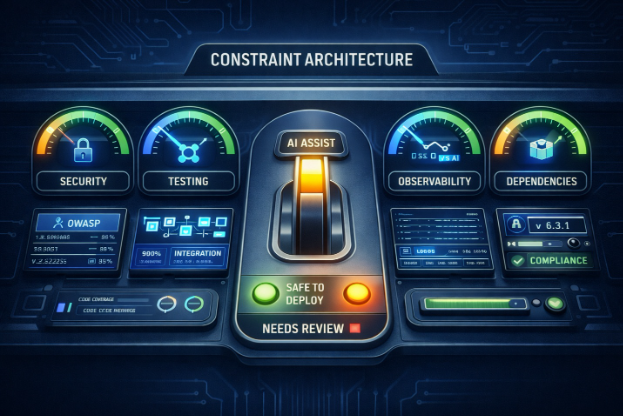
These are the gates I implement with clients:
1. Security Validation
- Automated scanning for OWASP Top 10 vulnerabilities.
- Mandatory architectural review for auth, data flow, and API exposure.
- Explicit approval for any AI-generated authentication, authorization, or payment logic.
2. Testing Requirements
- Minimum 80% coverage for critical paths with explicit edge cases.
- Integration tests for all external APIs.
- Load tests for components handling user-facing traffic.
3. Observability Standards
- Logging that tags AI-generated components for faster incident triage.
- Dashboards comparing AI-generated vs manually written code performance.
- Alert thresholds calibrated for AI-heavy workflows.
4. Rollback Strategy
- Ability to roll back AI-generated components without cascading failures.
- Feature flags for gradual rollout of AI-coded features.
- Documented recovery procedures specific to AI-related risks.
5. Documentation Requirements
- Captured AI rationale: Why this approach vs alternatives?
- Preserved prompt history and constraint decisions.
- Architecture decision records (ADRs) for significant AI-generated components.
Organizations that institutionalize these gates see vibe-coded applications perform comparably to traditional builds—with 40–60% faster time-to-market.
Strategic implication: Don’t forbid vibe coding from production. Define clear graduation criteria from prototype to production—and make these gates part of your CI/CD pipeline, not ad hoc review meetings. This is essential for enterprise AI governance at scale.
Myth 3: AI-Generated Code Is Inherently Less Secure
The misconception:
“Because AI can hallucinate or miss edge cases, vibe-coded apps are too risky from a security standpoint.”
The reality:
Security here is primarily a governance problem, not a generation problem.
Traditional development introduces vulnerabilities too—just via different failure modes. In one insurance BPO automation program I worked on, blind security audits consistently found that AI-generated code, when subject to stricter review processes, had fewer critical vulnerabilities than baseline manually written code.
The key is treating AI outputs as untrusted by default.
Security Best Practices for AI-Generated Code
1. Input Validation
- Assume AI will miss injection vectors; enforce automated checks.
- Prefer allowlists over AI-suggested blocklists.
2. Dependency Management
- AI often pulls outdated or obscure libraries.
- Lock versions and run automated security scans on AI-introduced dependencies.
- Schedule monthly audits for new dependencies added via AI.
3. Auth & Authorization
- Never ship AI-generated auth/permission logic without senior security review.
- Require manual verification for session management and access control logic.
4. Data Exposure Controls
- Explicitly classify data; don’t let AI decide what’s “safe enough.”
- Review AI-generated APIs for oversharing fields or PII.
- Use automated PII detection in code review for AI-generated endpoints.
Strategic implication: Security is a reason for governance, not a reason to avoid vibe coding. The organizations struggling the most are those trying to bolt traditional oversight onto a fundamentally different development model. Proper enterprise AI governance frameworks address these risks systematically.
Myth 4: AI-Assisted Development Creates Unmaintainable Technical Debt
The misconception:
“AI-generated code is a future maintenance nightmare. No one will want to touch it.”
The reality:
Maintainability has always been about architecture and intent, not the author’s job title—human or AI.
The real question is: Are you capturing architectural intent, or just outputs?
Bad vibe coding:
“Build me a payment system” → paste generated code → deploy.
Maintainable vibe coding:
“Build a payment system using Stripe, idempotent webhooks, and async job processing” → validate against standards → capture why you chose this approach → deploy with a runbook.
Practices That Keep AI-Generated Code Maintainable
- Preserve prompt history with key constraints and trade-offs.
- Document rejected approaches and why they were rejected.
- Enforce architectural standards so AI doesn’t fragment design patterns.
- Treat tests as documentation—AI-generated tests can reveal intent where comments don’t.
- Schedule regular refactor cycles with AI as the pair programmer, not as a one-shot generator.
Strategic implication: Make architectural documentation and prompt context required outputs of vibe coding sessions. That context—not the author—is what future teams need to safely extend the system.
Myth 5: AI Code Generators Commoditize Development Talent
The misconception:
“If AI generates most of the code, developers become interchangeable prompt operators.”
The reality:
Vibe coding is raising the bar for strategic talent. The skill premium is shifting from syntax and manual throughput to system thinking and constraint architecture.
In practice, I see three tiers emerging:
- Tier 1 – Commodity risk Developers who simply translate tickets into AI prompts, with shallow domain knowledge and little critical evaluation.
- Tier 2 – Valuable but not strategic Developers with strong fundamentals who can validate, debug, and harden AI-generated code.
- Tier 3 – Strategic advantage Developers who architect constraints and guide AI toward business outcomes:
- Deep domain expertise
- Ability to design systems that incorporate AI effectively
- Comfort translating ambiguous requirements into AI-compatible frameworks
Strategic implication: Your talent strategy should explicitly focus on growing Tier 3 capabilities. This is not “prompt engineering theater”; its product thinking + architecture applied to a new development model.
The Path Forward: Controlled Autonomy at Scale
Vibe coding is a leverage shift. Like any leverage, it amplifies both strengths and weaknesses.
The organizations that win with AI-assisted development implement controlled autonomy:
Enough AI freedom to unlock velocity; enough constraints to maintain reliability and trust.
Three Strategic Actions for Engineering Leaders
1. Audit Your Current State
- Where is vibe coding already happening informally?
- Which risks have you silently accepted?
- Which teams are seeing the best outcomes, and what are they doing differently?
- Which production incidents, if any, can be traced to AI-generated code?
2. Establish Explicit Governance
- Define production gates, security baselines, and documentation standards before broad rollout.
- Create an AI-specific code review checklist, distinct from traditional review.
- Track metrics for AI contribution vs. outcome quality (defects, incidents, rework).
3. Invest in Constraint Architecture
- Train senior developers as AI architects who design constraints and validate outputs.
- Build internal playbooks of successful prompt patterns and guardrails for your domain.
- Measure and reward the ability to guide AI toward production-viable solutions, not just clever demos.
The organizations winning with AI-assisted development aren’t those with the most aggressive adoption. They’re the ones with the most thoughtful implementation.
Five Questions to Ask Your AI Vendor (Due Diligence Checklist)
- Can you show correlation with CSAT? If not, it’s a vanity metric.
- Can we export our data? Demand portability.
- How do your metrics benchmark to industry standards?
- Who validates your AI’s accuracy? Independent audits only.
- What’s our exit strategy? Keep CSAT as the fallback.
FAQ: Enterprise Vibe Coding
1. Velocity: Time from concept to production.
2. Quality: Defect rates, incident volume, maintenance effort, and security findings.
Leading teams see 40–60% reduction in time-to-market with equal or better quality when proper governance is in place. Developer satisfaction is also a key signal—good AI workflows reduce toil and context switching.
Key takeaway: Your competitive advantage in AI-assisted development is not how fast you adopt, but how well you implement. Vibe coding with controlled autonomy lets you have both velocity and reliability.
What’s your biggest challenge in scaling AI-assisted development? If you’re wrestling with the gap between experimentation and production, that’s exactly where we help.