

Customer Experience
Scoring of agent conversations
Reduction in after call work
Reduction in QA costs
Accelerate Resolutions.
Instant responses across Email, Chat, and Microsoft Teams
Reduction in repetitive support inquiries
Faster resolution of technical customer questions

for Enterprise Operations
Accuracy In Data Extraction
Reduction in processing time
Cost Savings on Operations
Transform Enterprise Workflows
Workflows
Prototyping
Engineering

For Leading Healthcare Providers
Monitoring
HIPPA Compliance
Services
AI Developments Services
Chatbots & Virtual Assistants | AI Workflow Orchestration | AI Agents | Intelligent Document Automation
AI Insights From the Front Lines
Top 5 AI Use Cases Transforming Debt Recovery and Collections in 2026
Discover the top 5 AI use cases transforming debt recovery and collections in 2026. Learn how predictive analytics, conversational AI, and automation deliver up to 15% performance lifts, higher recovery rates, and major cost savings according to FICO and Experian.
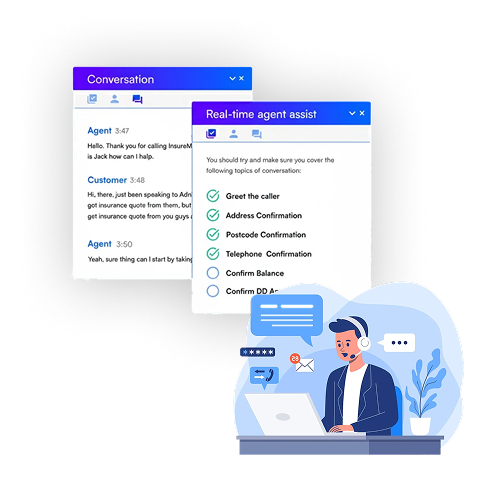
Real-Time Agent Assist: The Emerging Operating System for Customer Support
Real-time agent assist is emerging as the operating system for modern contact centers. Learn how AI-driven guidance improves AHT, agent performance, and CX outcomes.
AI-Powered Customer Support for Emergency Vet Clinics
Discover how AI-powered customer support solutions help emergency vet clinics handle high-stress calls with greater empathy, accuracy, and efficiency while reducing burnout and improving outcomes
Vibe Coding for Enterprise: Debunking 5 Myths and Deployment Best Practices
Whether you call it vibe coding, AI pair programming, or AI-assisted development with popular AI coding tools like Claude, Cursor, and GitHub Copilot, the velocity gains are real—teams shipping in days what previously took weeks.
But so are the risks when organizations scale without guardrails.
At this point, the real question isn’t whether to adopt vibe coding. Your teams are already using these tools. The real question is:
Why 74% of Production AI Agents Still Depend on Human Verification
The past year has delivered remarkable advances in large language models. Reasoning capabilities have improved. Context windows have expanded. Multimodal inputs are becoming standard. On paper, AI agents have never looked more capable.
The Top 10 CIO Concerns When Rolling Out AI Agents in the Enterprise
- AI adoption is widespread, but enterprise-wide scale remains rare. 88% use AI somewhere, but only a third scale—and fewer than 10% have scaled AI agents.
- Security, compliance, and governance concerns dominate. These remain the board’s #1 barrier to greenlighting large-scale AI agent deployments.
- ROI proof is the new currency. Most organizations report <5% EBIT impact from AI and struggle to measure value beyond pilot wins.
- Data, integration, and leadership capability gaps—not technology—are what kill agent programs. The gap between adoption and execution has never been wider.
A New Playbook for CSAT in the AI-Augmented Contact Center
- CSAT response rates average only 20–30 percent, sometimes as low as 5 percent—decisions are often based on a vocal minority.
- 78 percent of organizations now use AI in at least one business function, with rapid adoption in contact centers.
- It’s not CSAT vs. AI metrics—it’s integration. CSAT shows what happened; AI metrics reveal why and how to fix it.
- Validate AI metrics against CSAT before trusting them. If they don’t predict
- Vendor independence matters. If the same company sells the bot and the scorecard, ask who’s checking their math. satisfaction, they’re vanity metrics.