TL;DR
- AI drives up to 15% performance lifts in collections through predictive analytics, optimization, and data-driven strategies (FICO).
- Experian’s PowerCurve Collections analyzes over 1,000 factors per account daily, enabling precise prioritization, better cure strategies, and higher recovery rates.
- Leading operations, including Cox Communications, have achieved $2M+ annual cost savings, 40% more self-service payments, and significantly lower operational costs.
- Agencies adopting these tools are shifting from high-volume manual calls to smarter, empathetic, and fully compliant recovery processes.
The Shift: From Call Volume to Decision Precision
For decades, collections operations have been built on a simple premise: more calls, more recovery. That model is breaking down.
Today’s environment is fundamentally different. Regulations such as FDCPA, TCPA, and CFPB rules demand near-perfect compliance. Debtors are harder to reach, more digitally native, and less responsive to traditional outreach. At the same time, operational costs are rising and agent turnover remains high.
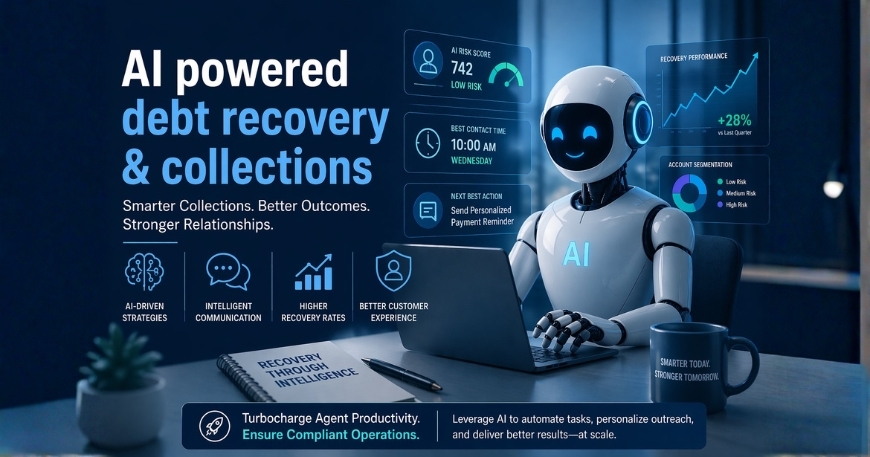
AI is not just improving collections—it is redefining the operating model.
The unit of work is shifting from calls made → decisions executed.
And the winners are not those who scale volume, but those who optimize every interaction with precision, compliance, and timing.
Where the ROI Actually Comes From
Not all AI use cases deliver equal value.
In practice, two capabilities anchor the ROI equation:
- After-Call Work (ACW) Reduction → delivers immediate, measurable cost savings and productivity gains
- Real-Time Compliance Monitoring → protects revenue, reduces regulatory exposure, and enables safe scaling
The remaining use cases—scoring, outreach, and omnichannel orchestration—amplify these two foundations.
If ACW reduction funds your AI investment, compliance is what protects it—and makes it scalable.
1. Predictive Analytics for Debtor Scoring, Prioritization & Segmentation
AI evaluates thousands of variables—payment behavior, credit signals, economic context, and interaction history—to assign each account a recovery probability. How it helps: Collections teams move away from treating all accounts equally. High-propensity accounts receive targeted attention, while low-yield efforts are minimized. Early signals help intervene before accounts deteriorate. Impact: FICO reports an average 15% performance lift when optimization and predictive models are applied effectively. Platforms like Experian PowerCurve analyze over 1,000 factors daily to continuously refine prioritization. Insight: Most agencies see limited ROI not because scoring is ineffective—but because it is not tightly coupled with execution workflows. Scoring without orchestration is underutilized intelligence.2. Personalized Communication, Outreach Optimization & Payment Plans
AI dynamically determines the optimal channel, timing, tone, and payment options for each debtor. How it helps: Generic scripts are replaced with contextual, empathetic engagement. Continuous testing improves outreach effectiveness over time. Impact: Higher response rates, stronger promise-to-pay commitments, and improved debtor relationships—often translating into faster and more consistent recoveries. Insight: Personalization is not just about messaging—it’s about meeting debtors where they are, when they are most likely to act.3. Conversational AI, Virtual Agents & Chatbots
AI-powered voice and chat interfaces enable 24/7 interaction—handling inquiries, reminders, negotiations, and self-service payments. How it helps: Scales outreach without proportional headcount while offering debtors convenient, always-available engagement channels. Impact: Higher containment rates, reduced agent workload, and improved accessibility for debtors outside traditional working hours. Insight: The real value is not cost reduction alone—it’s expanding the window of engagement beyond human constraints.4. Real-Time Compliance Monitoring & Risk Management
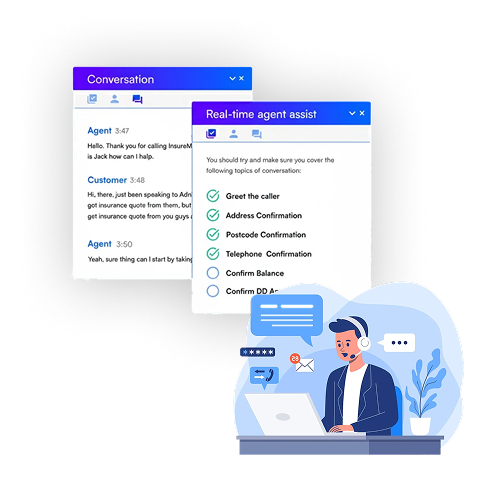
AI analyzes every interaction—calls, texts, and emails—in real time, flagging or preventing potential violations before they occur. How it helps: Shifts compliance from post-call audits to in-process enforcement, with automated QA, audit trails, and agent guidance. Impact: Reduced violations, lower regulatory risk, and stronger creditor confidence. In live deployments, agencies are realizing these gains through platforms like PulseAI360, especially in real-time compliance enforcement and after-call work reduction. Insight: Compliance is no longer just a control function—it is the foundation that enables scale without risk.5. Omnichannel Automation & Agent Performance Enhancement
AI orchestrates workflows across channels while augmenting agents with real-time guidance—sentiment insights, rebuttals, and best-practice prompts. How it helps: Streamlines end-to-end operations while improving agent effectiveness, especially for newer or less experienced staff. Impact: Lower cost-per-dollar-collected, improved consistency, and higher-quality interactions across the board. Insight: Omnichannel without orchestration creates noise. AI turns it into a coordinated system of engagement.How AI Is Delivering Real Value to Leading Operations
Leading agencies and lenders are already seeing measurable outcomes:
- Cox Communications (FICO platform) achieved:
- $2M+ annual cost reduction
- 40% increase in self-service payments
- 50% reduction in call center transactions
- FICO clients consistently report ~15% performance lift through optimized collections strategies
- Experian PowerCurve users benefit from continuous multi-factor analysis, leading to higher recovery rates and cost efficiencies
These results reinforce a simple reality:
AI in collections is no longer experimental—it is operational and outcome-driven.
Conclusion: Smarter, Safer, and More Human
Debt recovery is evolving from a volume-driven function to a precision-driven system of decisioning and engagement.
The agencies pulling ahead are not the ones making the most calls—they are the ones making the right decisions at the right time, with the right level of control.
- Costs decline because work is automated intelligently
- Compliance improves because risks are managed in real time
- Recovery rates increase because engagement becomes more relevant and respectful
The future of collections is not just AI-powered—it is AI-orchestrated and human-guided.
And the competitive edge will belong to those who can combine efficiency, compliance, and empathy at scale.
Five Questions to Ask Your AI Vendor (Due Diligence Checklist)
- Can you show correlation with CSAT? If not, it’s a vanity metric.
- Can we export our data? Demand portability.
- How do your metrics benchmark to industry standards?
- Who validates your AI’s accuracy? Independent audits only.
- What’s our exit strategy? Keep CSAT as the fallback.