
From Factory Gate to Compliance: Streamlining BIS Audits and Quality Orders
How automated gap analysis cross-checks active floor configurations against multi-page supplier bids and regulatory specifications in real time.
The minute a finished product rolls out of your loading dock, you lose direct control over it. Outside the safety of the factory gate, the stakes skyrocket—one minor paperwork error can mean impounded trucks, failed audits, and massive compliance penalties.
Traditionally, manufacturers rely on manual spot-checks to make sure that what was ordered, what the government requires, and what was actually built all match up. But when humans are forced to skim through thousands of pages of supplier bids and regulatory updates, oversights are bound to happen.
That is where AI-driven automated gap analysis comes in. Think of it as a digital gatekeeper that works in real time. By using advanced document intelligence, the system automatically cross-checks your live floor setup against messy supplier paperwork and strict regulatory guidelines on the fly – catching and fixing critical mismatches long before the shipment ever leaves your yard.
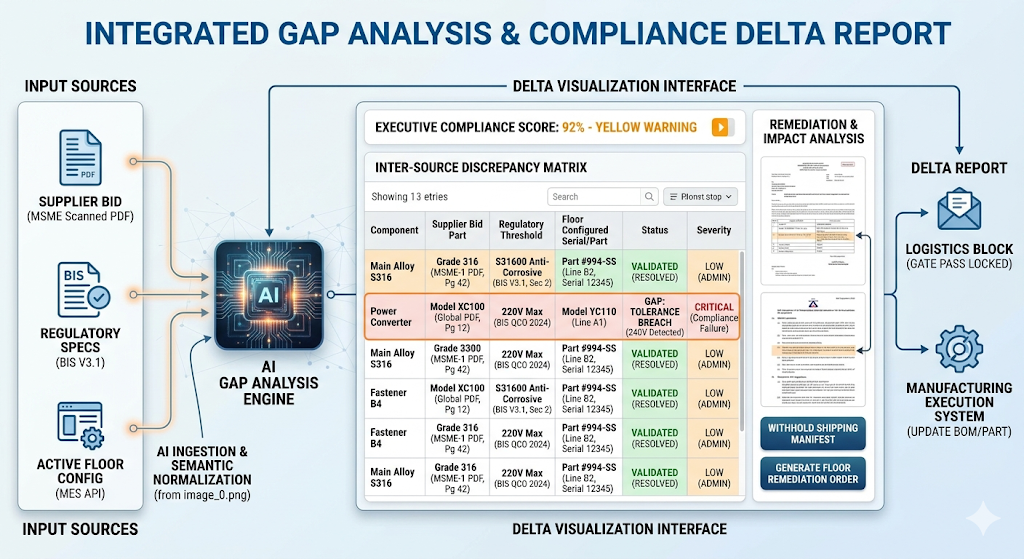
Integrated Gap Analysis Mock Architecture Diagram
The Tri-Factor Data Alignment Architecture
To catch mismatches on the fly, the AI ingestion engine runs three completely different data types through a central translator. This normalizes everything into a unified baseline, matching up different terms used for the same parts or specs.
1. Ingesting Unstructured Supplier Bids (The “As-Offered”):
Supplier bids are notoriously messy. They span dozens of pages of inconsistent PDFs, complex tables, hidden component notes, and regional part numbers. Instead of treating these as flat text, the AI uses layout-aware models to understand tables, headers, and footnotes—turning static documents into a dynamic, searchable data map.
2. Parsing Regulatory Guidelines (The “As-Required”):
Compliance rules (like ISO standards or localized safety mandates) set the hard legal boundaries for what you can ship. The system keeps an updated database of these laws and uses large language models to cut through dense legalese and extract exact numeric safety and quality thresholds.
3. Monitoring Active Floor Configurations (The “As-Built”):
This is the live state of your assembly line, pulled directly from your factory software (like MES, ERP, or live Bill of Materials data). The system connects to live data streams to capture exact serial numbers, firmware versions, physical dimensions, and part attributes currently on the floor.
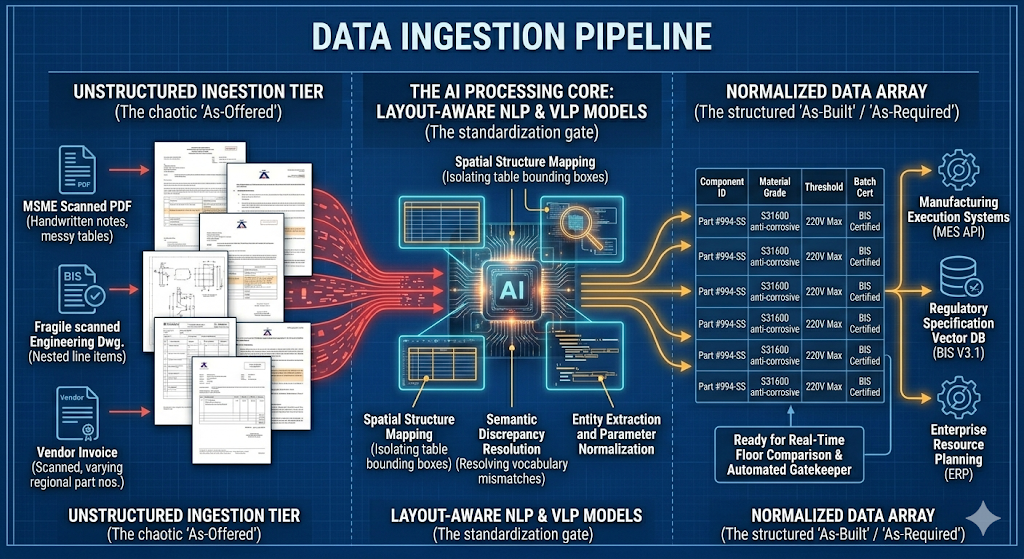
Technical Schematic of Data Ingestion Pipeline
How the On-The-Fly Cross-Checking Engine Works
Once the data is ingested, the AI executes a quick, three-step check in a matter of seconds.
Step 1: Matching the Names (Standardization)
The AI instantly spots vocabulary mismatches across datasets. If a supplier bid says “Grade 316 Stainless Handle,” a government rule requires “S31600 anti-corrosive alloy,” and your assembly floor reads “Part #994-SS,” the engine automatically recognizes that all three are the exact same physical part.
Step 2: Checking the Rules (Boundary Checking)
Next, the engine runs live mathematical and logical cross-checks. It matches the actual power draw or dimensions of the built part against what the supplier promised and what the law allows. If a tolerance window is missed by even a fraction, the system rings an alarm.
Step 3: Assessing the Damage (Impact Analysis)
Instead of just throwing a generic error code for a missing item, the AI figures out the real-world operational impact. It instantly tells you if a variance is a critical compliance failure (like an uncertified safety valve) or just a harmless administrative typo.
Localization Focus: The Indian Manufacturing Landscape
While the core software setup works anywhere, applying it in India means dealing with unique supply chain pressures, rapid regulatory updates, and strict local enforcement.
1.Navigating India-Specific Compliance Pressures
In India, paperwork errors quickly turn into major operational bottlenecks or massive legal fines at the gate:
- BIS & QCOs (Quality Control Orders): The government has aggressively expanded mandatory QCO rules across steel, electronics, chemicals, and machinery. Shipping a product with even one non-compliant component can completely halt your export or domestic clearances. Cross-checking your active assembly lines against a live BIS database stops these compliance disasters before they happen.
- GST & E-Way Bill Violations: The moment a truck leaves the yard, the physical inventory must match your digital E-Way bills and e-invoices with absolute precision. Any discrepancy between what’s on the truck and what’s on the invoice leads to immediate transit delays and vehicle seizures at state borders. Automated gap analysis guarantees the data matches before the engine starts.
2.Normalizing Paperwork from Fragmented MSME Suppliers
Unlike Western supply chains that rely on highly digitalized suppliers, Indian manufacturing depends heavily on a deep network of domestic MSMEs (Micro, Small, and Medium Enterprises). While Tier-1 vendors send clean digital data, smaller Tier-2 and Tier-3 shops often submit paperwork as scanned, handwritten invoices or unstructured images. The AI reads and normalizes these messy formats seamlessly, giving you total quality control without forcing small domestic suppliers to buy expensive software.
3.Shifting from “Jugaad” to Zero-Defect Manufacturing
Driven by “Make in India” and global “China+1” sourcing strategies, Indian industry is moving away from quick, temporary fixes (jugaad) and stepping up to world-class Zero-Defect, Zero-Effect (ZED) standards. Using a real-time AI gatekeeper lets Indian manufacturers mathematically prove to global buyers that human oversight has been engineered out of the final validation process.
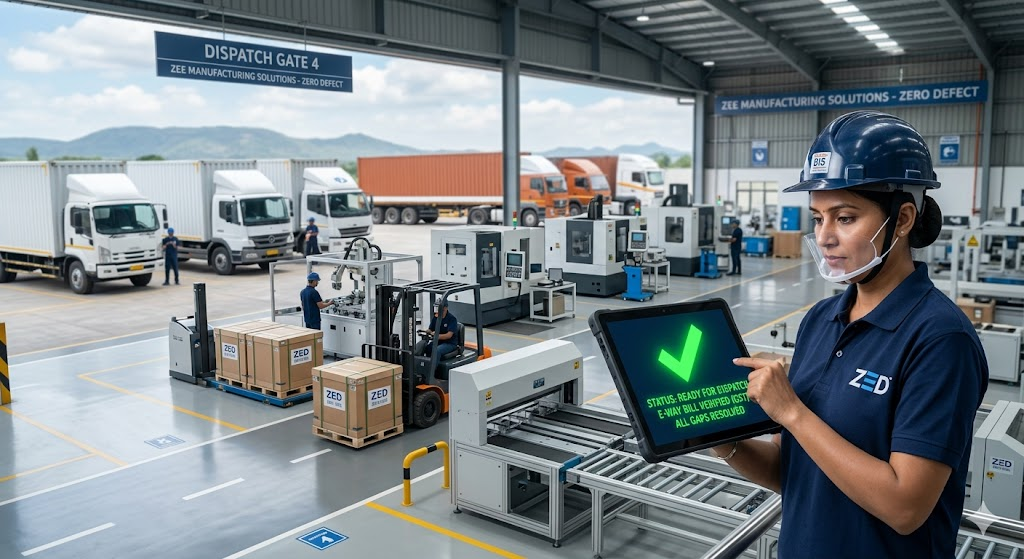
Smart Quality Gate and Logistics Verification Industrial Scene
Inside the Delta Report Architecture
To make this actionable, the system drops these insights into a live dashboard that acts as a physical gatekeeper right at the edge of the shipping yard:
- Automated Shipping Gatekeepers: The AI integrates directly with your yard and fleet management software. If a high-priority compliance gap isn’t fixed, the system automatically freezes the digital shipping manifest, locking the asset’s status and preventing the logistics team from printing a gate pass.
- Clear Fix-It Guides for Floor Managers: When a mismatch is found, the AI doesn’t just say “Error.” It generates a clear delta report for the shop floor, pinpointing the exact page of the supplier bid and the specific section of the regulatory code that caused the conflict so teams can fix it fast.
- Catching Unauthorized Part Substitutions: If a supplier quietly substituted a component due to shortages, the AI flags whether that substitute actually matches your original regulatory contract before the unit is boxed up, saving you from expensive product returns and contract penalties.
By replacing manual document skimming with automated, smart cross-checking, modern plants move away from fingers-crossed “acceptable risk” and achieve absolute verification certainty at the very final inch of the production line.
Key Operational Takeaway: When presenting this solution to manufacturing leaders, frame it as a functional shield. It isn’t just an IT upgrade; it’s a protective layer that stops border/GST fines, normalizes messy MSME supplier paperwork, and unlocks global export readiness.
The Next Step for Your Assembly and Compliance Strategy
Replacing slow, manual document checking requires connecting your live factory floor operations directly to intelligent parsing tools.
At Trellissoft, we specialize in building advanced document intelligence workflows designed for modern manufacturing ecosystems to stop costly compliance and configuration errors before they happen.
The Docuvera360 Framework
Let our automation and strategic partnership experts show you how introducing Docuvera360 can cleanly connect your live assembly lines and ERP data straight to your regulatory and supplier databases, keeping your operations seamless, compliant, and ready for global export.