
TL;DR: 4 Things Every CIO Should Know:
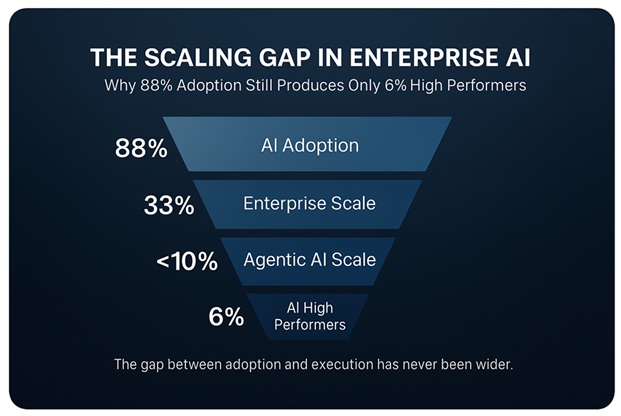
- AI adoption is widespread, but enterprise-wide scale remains rare. 88% use AI somewhere, but only a third scale—and fewer than 10% have scaled AI agents.
- Security, compliance, and governance concerns dominate. These remain the board’s #1 barrier to greenlighting large-scale AI agent deployments.
- ROI proof is the new currency. Most organizations report <5% EBIT impact from AI and struggle to measure value beyond pilot wins.
- Data, integration, and leadership capability gaps—not technology—are what kill agent programs. The gap between adoption and execution has never been wider.
The Scaling Paradox
AI adoption has exploded across the enterprise—88% of companies now use AI in at least one business function, yet only one-third are scaling these systems enterprise-wide (McKinsey Global Survey, Nov 2025). And while interest in agentic AI has surged, fewer than 10% of organizations have scaled AI agents beyond pilot mode. The gap between adoption and execution has never been wider.
The CIO’s Top 10 Concerns:
1. Data Privacy, Security & Compliance Risks (Still the #1 board concern)
AI agents introduce new surface areas for data leakage, privilege escalation, and unauthorized system actions. Boards now evaluate AI risk with the same seriousness as cyber threats. Board risk: regulatory exposure, litigation, reputational damage.
2. Inability to Measure ROI & Demonstrate Business Value
CFOs are done with demos—they want measurable outcomes. Yet most organizations report that AI contributes less than 5% to EBIT (McKinsey, 2025). Why it matters: Scaling requests stall when financial impact cannot be proven.
3. Governance, Ethics & the Regulatory Wave
With the EU AI Act entering enforcement in 2026 and sector-specific AI Regulations accelerating in the U.S., governance can no longer be a “phase two” initiative. Board risk: compliance failures, audit findings, enforcement actions.
4. Lack of Trust, Transparency & Explainability
Most CIOs still hesitate to give agents unsupervised autonomy. Without explainability, boards cannot defend AI-driven decisions to regulators or customers. Board risk: inability to explain or justify autonomous actions.
5. Executive Leadership Capability Gap
AI transformation is a leadership challenge—not a technical one. CEOs rate only 44% of CIOs as “AI-savvy” (Gartner, 2025). Why it matters: Expectation-execution misalignment slows enterprise momentum.
6. Integration Complexity & Technical Debt
Legacy systems, brittle integrations, and fragmented workflows prevent agents from operating reliably at scale. Integration consumes up to 40% of IT team resources in many enterprises. Board risk: delayed time-to-value, escalating modernization costs.
7. Cost Uncertainty & Hidden Infrastructure Expenses
Token usage spikes, observability tooling, retraining cycles, and the human cost of change management may turn many $2M pilot budgets into $20M+ surprises. Board risk: uncontrollable OPEX and budget variance.
8. Data Quality, Availability & AI Readiness
Weak data foundations cripple agent performance. 65% of organizations either lack or are unsure if they have AI-ready data (Gartner, 2025). Why it matters: Poor data leads to hallucinations, drift, and accuracy failures at scale.
9. Scaling, Performance & Observability Gaps
CIOs increasingly ask: “How do we know our 500 agents are behaving across four million interactions a month?” Without instrumentation, drift detection, and auto-rollback mechanisms, scaling becomes reckless. Board risk: operational disruption and reputational damage.
10. Organizational Resistance & Change Fatigue
Employees are ready—but processes, incentives, and leadership alignment often are not. “Innovation theater” replaces true adoption when change management lags. Board risk: low adoption despite investment.
What Separates Winners from Laggards
The enterprises succeeding with AI agents are the ones following a disciplined sequence:
- Security and governance first. Nothing else scales without trust.
- Fix foundations. Technical debt and bad data kill more AI programs than weak models.
- Prove value ruthlessly. 90-day ROI targets; no vanity metrics.
- Build observability from day one. You can’t scale what you can’t monitor.
- Prepare the human system. Leadership fluency and change readiness determine adoption.
The data is clear: 88% are trying or bogged down in pilot. Only 6% are truly scaling. Execution discipline is the secret sauce.
Five Questions to Ask Your AI Vendor (Due Diligence Checklist)
- Can you show correlation with CSAT? If not, it’s a vanity metric.
- Can we export our data? Demand portability.
- How do your metrics benchmark to industry standards?
- Who validates your AI’s accuracy? Independent audits only.
- What’s our exit strategy? Keep CSAT as the fallback.