
Swedish fintech leader Klarna, which pioneered the Buy Now Pay Later concept, has deployed a customer support AI assistant that now handles two-thirds of its customer service chats. This Assistant handles the workload of 700 agents and has reduced the query resolution time by 80%.
Similarly, Salesforce, whose customer support portal receives more than 60 million visits per year, transitioned its support infrastructure for this portal in late 2024 to a 100% AI Agent-based digital labor platform powered by Agentforce.
According to Kari Briski, VP of enterprise AI at Nvidia, “One in ten organizations are using AI agents today, and over 80% plan to adopt them within three years.” Read more.
The AI agent revolution is rapidly unfolding across enterprises, unleashing a new wave of productivity and transforming the future of work.
Here, we explore the defining characteristics of AI agents and how they are reshaping industries.
Key Characteristics of AI Agents
Autonomy: AI agents operate independently, managing workflows end-to-end without continuous human intervention.
Example: Klarna’s AI assistant autonomously processes refunds, updates payment schedules, and resolves queries without human support.
Goal-Oriented Behavior: These agents optimize their actions to achieve specific outcomes based on predefined objectives or learned priorities.
Example: In e-commerce, an AI agent managing dynamic pricing adjusts product prices in real time to maximize revenue while staying competitive.
Context Awareness: AI agents leverage data, user interactions, and environmental cues to dynamically adapt and make informed decisions.
Example: A financial AI agent recommends portfolio adjustments based on market trends and a user’s risk profile.
Learning Capability: By analyzing past interactions and outcomes, AI agents continuously improve their performance.
Example: A fraud detection agent in banking refines its ability to identify suspicious transactions by learning from emerging fraud patterns.
Multi-Agent Collaboration: AI agents work collaboratively with other agents to handle complex, interconnected tasks.
Example: In autonomous driving systems, multiple AI agents collaborate seamlessly to ensure safety, from object detection to traffic navigation.
End-to-End Execution: AI agents complete entire processes autonomously, enhancing operational efficiency.
Example: In HR, an AI agent automates onboarding tasks like sending offer letters, verifying documents, and scheduling orientations.
These attributes make AI agents indispensable tools for managing complex workflows at scale.
AI Agent Use Cases
AI agents are gaining accelerated traction in various enterprise domains. Let us examine three prominent use cases:
-
Software Development
Generative AI tools like GitHub, CoPilot & Replit are revolutionizing the software development lifecycle by automating code development and testing. Agentic tools like Devin and Factory.ai further accelerate engineering velocity, bringing autonomy to code generation. - Customer Support
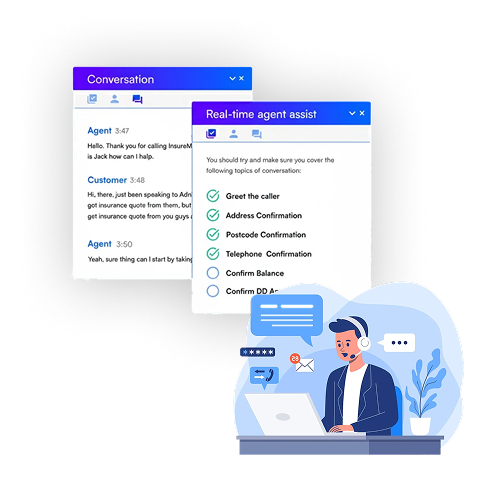
Trellissoft’s PulseAI360 AI agent is empowering contact centers to enhance service quality and productivity. Features like AI-generated call summaries capture key insights, including customer sentiment analysis, script and compliance adherence and call grading to facilitate real time coaching & feedback to agents. - Legal Operations
Corporate law departments and firms leverage AI tools like Harvey for legal research, summarizing lengthy documents, building timelines & contract drafting. Trellissoft is working with a professional services firm to automate the client intake process by leveraging AI for intelligent document parsing, data extraction, and analysis & compliance checks against state laws.
These use cases highlight the versatility of AI agents, which are poised for adoption across various enterprise functions.
Key Challenges with AI Agent Deployments
Despite their transformative potential, deploying AI agents comes with challenges:
- Data Quality and Availability: Poor quality or insufficient data can hinder performance.
- Integration Complexity: AI agents must integrate seamlessly with existing systems, which can be a hurdle with outdated infrastructure.
- Scalability: Expanding AI agents to handle more workloads can drive up compute and infrastructure costs.
- Bias and Fairness: Training data biases may lead to unfair outcomes, especially in sensitive use cases.
- Lack of Explainability: Many AI agents function as “black boxes,” complicating transparency.
- Regulatory Compliance: Adhering to standards like GDPR, state employment bias mandates or the EU AI Act adds complexity.
- Monitoring and Maintenance: Continuous monitoring is crucial to address errors and maintaining performance.
While these challenges may seem daunting, advancements in AI technologies are progressively mitigating these barriers.
Raising the Bar for the C-Suite
Integrating AI agents into enterprise workflows requires careful preparation. Tracing and oversight of Agent performance are needed along with robust AI governance frameworks for AI Lifecycle Management.
For the C-suite, this shift also involves managing a composite workforce where humans and AI agents collaborate to get work done. Leaders must reimagine roles, foster collaboration, and adapt flexible organizational structures to maximize AI’s strategic value.
Are you ready to explore how AI agents can transform your customer service? Talk to one of our experts today.
Harish Bhat is the Chief AI Officer at Trellissoft Inc., committed to empowering customers to leverage AI for enhancing operations and driving transformative productivity. He is also the author of Demystifying Prompt Engineering: AI Prompts at Your Fingertips, a step-by-step guide to mastering effective communication with Large Language Models.