
The Call No One Is Ready For
It’s just before 11 p.m. when the phone rings — again.
On the line is a pet owner whose dog may have ingested something toxic. Their words come fast and uneven, panic bleeding through every sentence. They need to know what to do now.
On this end, a customer support agent at an emergency veterinary practice inhales, buying a second. The call queue is backing up. Protocols blur under pressure. One unclear instruction or moment of hesitation could escalate fear — or delay care.
In moments like this, customer support isn’t a function.
It’s the front line of care.
Why Emergency Vet Customer Support Is Different
Emergency veterinary care operates where emotional distress, time pressure, clinical uncertainty, and financial shock collide.
Pet owners aren’t simply seeking information. They’re making high-stakes decisions under stress, often for the first time. Support agents are expected to respond with empathy, accuracy, and confidence — frequently with incomplete context and no margin for error.
Traditional customer support models weren’t designed for this environment. Scripts slow response. Knowledge bases fragment attention. Even experienced agents struggle when emotional load peaks.
In emergency vet care, emotional intensity shapes everything downstream.
The Core Issues Undermining Emergency Vet Customer Support
Staffing shortages and burnout place constant pressure on frontline teams. Long hours and compassion fatigue drive turnover, leaving fewer experienced agents to handle the most difficult interactions.
Clarity under stress breaks down. During emergencies, uncertainty around next steps creates confusion, repeat calls, and erosion of trust — even when agents are doing their best.
After-hours demand spikes intensify the problem. Nights and weekends compress staffing while urgency rises, forcing agents to manage multiple crises at once.
These pressures compound. When they do, both customer experience and staff sustainability suffer.
A Real-World Scenario: Where Things Break
A late-night call comes in about possible chocolate ingestion.
The agent is managing multiple lines while searching internal systems for toxicity thresholds. They’re calming the caller and recalling protocols at the same time. The call runs longer than it should. Anxiety escalates. The agent hesitates, aware that the wrong guidance carries consequences.
When the call ends, there’s no pause. Notes must be written. Details documented. Another crisis waits on hold.
Context is rushed. Nuance is lost.
More than failure of effort, it’s a failure of support.
Customer Support as Care Infrastructure
In emergency veterinary care, customer support directly affects outcomes.
It shapes how quickly pets receive treatment, how confident owners feel making decisions, how accurately information is handed off to clinical teams, and how long frontline staff can sustain themselves.
The care journey is influenced long before a veterinarian sees the animal.
Are your customer support teams enabled to perform under sustained emotional pressure?
How AI Customer Support Helps — When Designed for the Moment
Delivering exceptional customer service means placing AI agents, copilots, and humans exactly where they create the most value — especially in high-stakes, emotionally charged moments like emergency veterinary care.
In practice, that value shows up during the interaction itself — when human judgment needs support, not distraction.
Real-Time Agent Assist: Confidence at the Point of Care
Under pressure, agents don’t struggle with empathy. They struggle with cognitive overload.
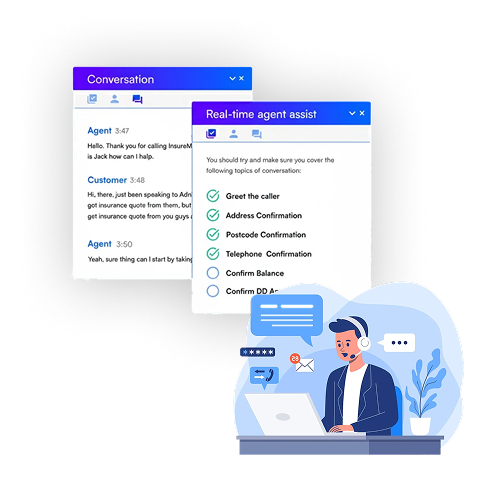
Real-time AI agent assist supports agents during live calls by surfacing empathy cues, triage questions, and protocol reminders at the right moment — without forcing them to search or second-guess.
When agents are supported this way, first-call resolution improves materially. Organizations deploying real-time agent assist in high-emotion contact center environments consistently report improvements in the range of 20–25%, because uncertainty is resolved during the interaction rather than pushed into follow-up calls.
The result is calmer conversations, clearer next steps, and fewer escalations — not because agents move faster, but because they move with confidence.
AI Call Summaries: Reducing After-Call Load
Emergency calls leave a residue. Agents are expected to document accurately while emotionally depleted and immediately prepare for the next crisis.
AI-generated call summaries capture facts, urgency, and next steps automatically. Across implementations in high-volume contact centers, 50–60% reductions in after-call work are consistently observed — not from rushing documentation, but from eliminating recall and rework entirely.
This creates space for agents to reset between calls and ensures continuity for downstream care teams.
In emergency vet environments, documentation isn’t paperwork.
It’s a handoff of responsibility.
AI-Powered QA and Coaching: From Sampling to Visibility
Most support teams still review 3–5% of interactions manually. That approach misses the emotionally charged moments where breakdowns occur.
AI changes this by analyzing 100% of interactions, surfacing patterns across time, scenarios, and agents. Coaching becomes timely and specific. Supervisors spend less time auditing and more time developing skills.
This continuous feedback loop accelerates onboarding, reduces repeat mistakes, and improves consistency under pressure. As these upstream behaviors improve, customer satisfaction follows naturally — teams in practice see 10–15% CSAT lifts driven by genuinely better experiences, not tighter scripts.
Revisiting the Scenario — With Support in Place
Now imagine that same late-night poisoning call.
The agent receives real-time guidance to acknowledge panic immediately, ask the right questions early, and deliver clear next steps without hesitation. They stay focused on the caller instead of navigating systems.
After the call, a concise summary is generated automatically. The agent takes a breath — and is ready for the next interaction.
It is all about leveraging technology to turbocharge agent productivity.
A Human-Centered Approach: PulseAI360
At Trellissoft, we built PulseAI360 specifically for high-stakes, high-emotion environments like emergency veterinary care — where generic contact center tooling falls short.
Most AI platforms treat call summaries, agent assist, and QA as separate modules bolted together. PulseAI360 integrates them as a single, continuous support layer — one that learns from every interaction, adapts to the emotional register of each call, and strengthens human judgment in real time rather than reviewing it after the fact.
PulseAI360 goes beyond automating support.
It’s about making the people delivering it genuinely more capable under pressure.
From Crisis Calls to Compassionate Care
Emergency veterinary teams show up when it matters most. Supporting them requires systems designed for emotional reality — not generic customer support tooling retrofitted for a clinical context.
When applied thoughtfully, AI transforms customer support into a pillar of compassionate care — improving outcomes for pets, owners, and the people answering the phone at 11 p.m.
Because the hardest calls shouldn’t be handled alone.
Interested in seeing how PulseAI360 performs in high-stakes environments? Schedule a demo
Five Questions to Ask Your AI Vendor (Due Diligence Checklist)
- Can you show correlation with CSAT? If not, it’s a vanity metric.
- Can we export our data? Demand portability.
- How do your metrics benchmark to industry standards?
- Who validates your AI’s accuracy? Independent audits only.
- What’s our exit strategy? Keep CSAT as the fallback.