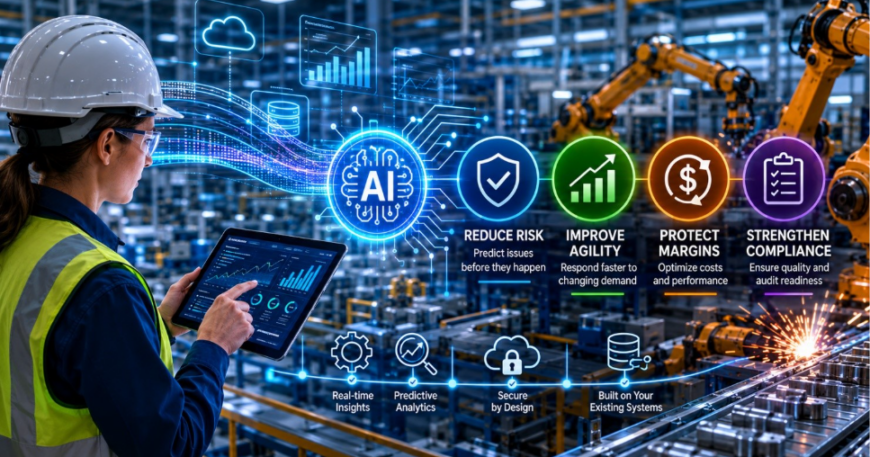
A delayed supplier email, an overlooked certification, or an unnoticed demand shift can disrupt production long before anyone realizes there’s a problem.
Every day, manufacturers receive a constant stream of supplier emails, invoices, purchase orders, material certifications, quality reports, and customer communications. Hidden inside these everyday documents are early warning signs of supply disruptions, changing demand, rising costs, and compliance risks.
Yet, these signals often remain trapped inside inboxes, PDFs, spreadsheets, and disconnected systems – only surfacing after production schedules, customer deliveries, or margins have already been affected.
The challenge most manufacturers face isn’t a lack of information. It’s that most of their information never becomes actionable intelligence.
Most manufacturers assume solving this requires replacing their ERP or embarking on a multi-year manufacturing digital transformation initiative. The reality is, manufacturers can move from reactive firefighting to proactive, data-driven decision-making—without replacing the systems they already rely on.
The Four AI Capabilities At a Glance
Not every manufacturer faces the same operational challenges. Some struggle with supplier disruptions, others with volatile demand, shrinking margins, or growing compliance requirements.
The four capabilities below target the most common pain points in manufacturing and can be introduced incrementally to achieve manufacturing automation – without replacing your existing ERP or core business systems.
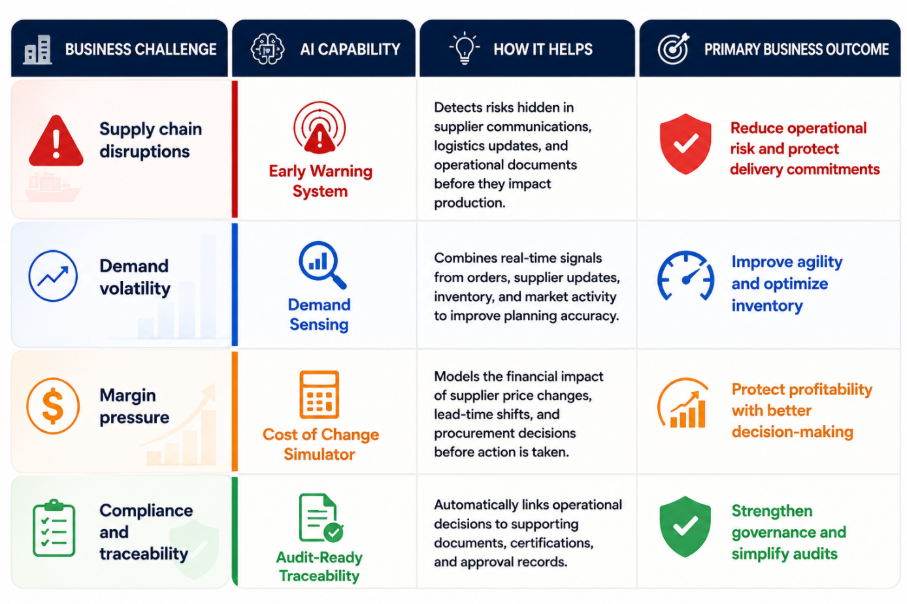
The common thread? Every capability begins by transforming information trapped inside emails, PDFs, invoices, certifications, and supplier communications into structured, decision-ready intelligence.
Let’s explore how each capability works, the business problem it solves, and the measurable value it can deliver – using the systems you already have.
1. The Early Warning System
Proactive Supply Chain Risk Management
The Problem
Many manufacturers only discover supply chain issues after production schedules have already been affected.
By the time procurement learns that a shipment is delayed or a supplier cannot fulfill an order, valuable days—or even weeks—have been lost.
What AI Does Differently
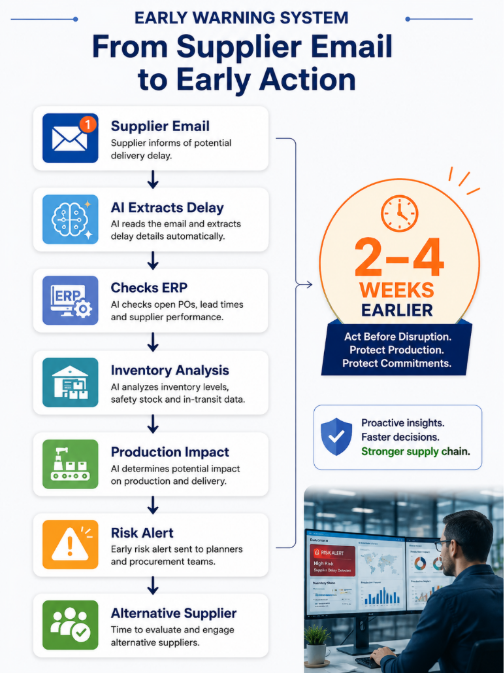
When a supplier communicates a potential delay, AI uses intelligent document processing to automatically extract the information and compare it against purchase orders, inventory levels, supplier performance, and production schedules. Then it alerts planners before production is affected.
The result is an always-on early warning system for emerging supply chain risks.
Business Benefit
Instead of reacting after production is impacted, manufacturers gain a valuable 2–4 weeks window to:
- Secure alternative suppliers
- Adjust production schedules
- Protect customer delivery commitments
- Reduce expensive last-minute decisions
According to McKinsey, improving supply chain resilience requires greater visibility into disruptions and the ability to respond proactively before operations are impacted.
2. Demand Sensing
Moving Beyond Traditional Forecasting
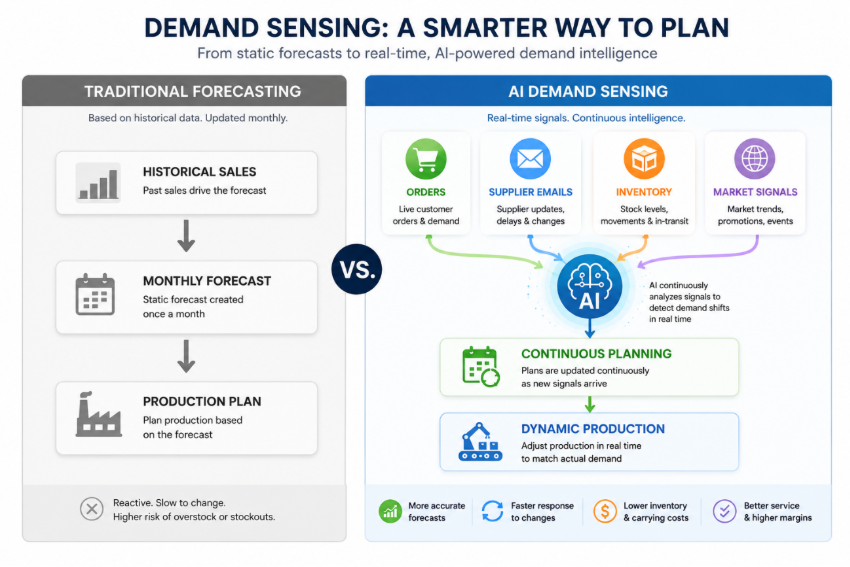
What AI Does Differently
- Customer orders
- Supplier communications
- Inventory movements
- Logistics updates
- Market activity
By continuously analyzing these signals, AI creates a real-time view of demand that enables more responsive production planning.
Deloitte describes how digital supply networks transform disconnected supply chains into connected ecosystems capable of supporting faster, data-driven decision-making.
Business Benefit
Manufacturers can:
- Improve material availability
- Respond faster to changing customer demand – whether demand rises or falls.
- Reduce excess inventory
- Improve production planning accuracy
The result is a more agile supply chain without replacing existing planning tools.
3. The Cost of Change Simulator
Protecting Margins Before They Erode
Supplier costs, lead times, and freight charges change constantly, affecting profitability across the enterprise.
Each change affects profitability—but understanding the full impact often requires manual analysis across multiple departments.
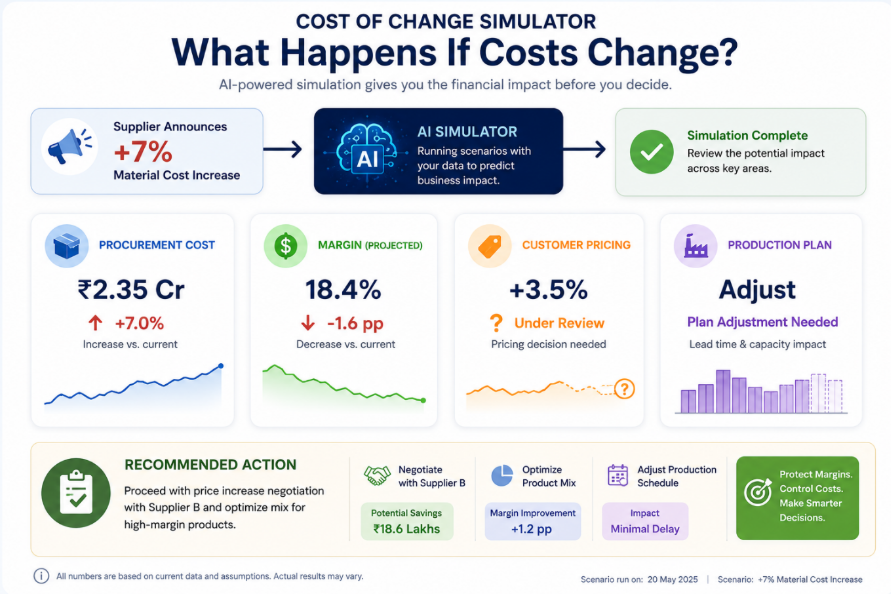
What AI Does Differently
Suppose a supplier announces a 7% increase in material pricing.
Instead of simply updating procurement records, AI immediately models how the increase affects:
- Procurement costs
- Product margins
- Customer pricing
- Production profitability
Business Benefit
Rather than reacting to rising costs after margins have already fallen, procurement and finance teams can make informed decisions based on projected business outcomes.
This transforms procurement from reactive purchasing into proactive financial planning.
4. Audit-Ready Traceability
Compliance Built Into Everyday Operations
Preparing for an audit often means collecting documents from multiple departments and manually reconstructing why specific operational decisions were made.
The process is time-consuming and stressful.
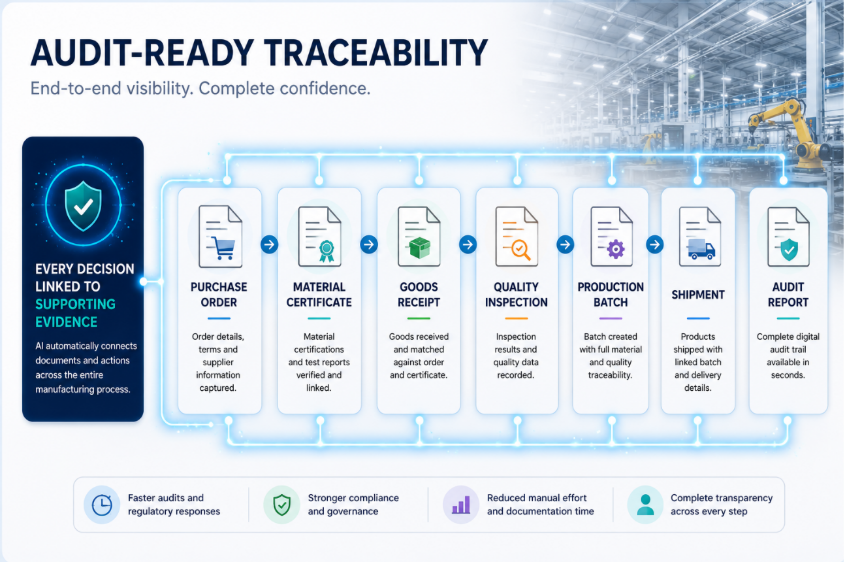
What AI Does Differently
AI automatically links every operational decision back to its supporting documents.
For example, a quality decision can be traced directly to:
- Material certification
- Supplier documentation
- Inspection reports
- Purchase orders
- Approval records
Every step becomes part of a searchable end-to-end digital audit trail.
NASSCOM highlights how Intelligent Document Processing enables organizations to convert unstructured business documents into searchable, decision-ready information that supports governance and compliance.
Business Benefit
Manufacturers can:
- Produce evidence quickly during audits
- Reduce manual compliance effort
- Improve governance
- Increase confidence in regulatory reporting
Instead of preparing for audits, organizations remain audit-ready every day.
Proven Business Impact
Manufacturers implementing AI-powered intelligent document processing are already seeing measurable operational improvements. From earlier risk detection and real-time operational visibility to faster decision-making and significant reductions in manual processing effort, AI is transforming fragmented operational data into actionable intelligence.
The result is a more resilient, agile, and efficient manufacturing operation – one that can respond faster to disruptions, protect profitability, and strengthen compliance across the enterprise.
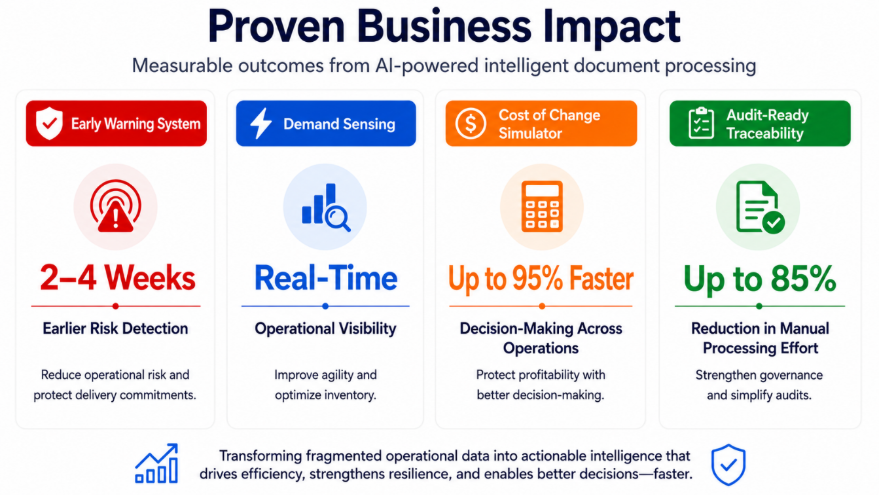
By connecting and contextualizing data across documents, systems, and operational workflows, Trellissoft’s DocuVera360 enables manufacturers to detect risks earlier, improve visibility, and make faster, data-driven decisions.
NASSCOM Community – Intelligent Document Processing: Global Impact and Industry Adoption
Key Takeaways
Manufacturers don’t need to replace their ERP or launch a multi-year modernization initiative before benefiting from AI.
By adding an intelligent AI layer on top of existing systems, organizations can unlock operational intelligence already hidden inside everyday business documents.
The result is a more resilient, agile, profitable, and compliant manufacturing operation—while laying the foundation for broader manufacturing digital transformation initiatives.
Ready to Get Started?
Manufacturers don’t need to wait years to become AI-enabled.
The operational intelligence required to reduce risk, improve agility, protect margins, and simplify compliance already exists inside the documents your business processes every day.
The question is whether you’re putting it to work.
Ready to identify where AI can deliver the fastest impact in your manufacturing operations?
Schedule a personalized demonstration or an Enterprise Data Readiness Assessment to see how DocuVera360 can transform operational documents into actionable intelligence—without replacing your existing systems.
FAQ
Rather than replacing core systems, it unlocks the information trapped inside everyday documents and delivers immediate operational improvements while supporting longer-term modernization strategies.