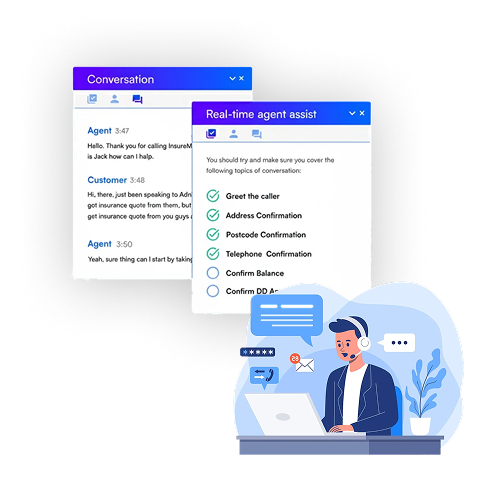

AI is redefining how customer experience is managed — in real time.
A Fragmented Stack That Fails at the Moment That Matters Most
For decades, contact centers have operated on a fragmented technology stack — CRM systems for customer data, knowledge bases for answers, QA platforms for compliance, and coaching programs for development.
Yet when a customer interaction actually unfolds, agents are largely left navigating these systems on their own, in real time, under pressure.
What has been missing is not better post-call analysis. Most support organizations already have that. What has been missing is technology that helps agents make better decisions during the interaction itself.
Real-time AI agent assist is beginning to fill that gap — and in doing so, it is emerging as the operating system for modern customer support.
This shift reflects a broader evolution in contact center AI. For years, organizations have invested in systems that record interactions, analyze performance, and improve processes after the fact. What has been largely absent is a system that provides guidance in the moment decisions are made.
Real-time agent assist transforms support technology from passive systems of record into active systems of guidance.
The Conditions Are Finally Right
Real-time agent assist is not a new concept. What has changed is technology’s ability to execute on it reliably.
Three shifts have converged:
- Large language models can now interpret conversational context with sufficient accuracy to generate useful real-time guidance
- Real-time transcription accuracy has improved significantly, reducing latency and error rates
- Deployment costs have declined, making enterprise-grade implementations viable beyond the largest contact centers
The result is a category moving from pilot experimentation to production deployment at measurable scale.
For the first time, real-time guidance is not just possible — it is operationally reliable at scale.
Why Traditional Contact Center Tools Fail in Live Interaction
Most contact center technology has been designed for analysis after the call ends.
Speech analytics tools review recordings post-interaction. QA teams audit only a small percentage of calls. Coaching happens days later. Knowledge bases depend on agents knowing what to search for while handling a live issue.
These tools are valuable for continuous improvement, but they share a critical limitation: they operate outside the moment when decisions must be made.
Customer experience is shaped during the interaction — when an agent must interpret policy, respond to objections, and resolve issues while the customer is still engaged.
Without real-time guidance, agents rely on memory and experience, which drives variability at scale.
What Real-Time Agent Assist Actually Does
Real-time agent assist introduces a new operational layer in modern customer support and contact center AI systems.
By combining live transcription, conversational AI, and workflow automation, these systems monitor interactions as they unfold and deliver contextual guidance directly within the agent’s interface — without requiring manual search.
During a live interaction, these systems can:
- Surface relevant knowledge articles based on customer context
- Recommend next-best actions or resolution paths
- Flag compliance requirements in real time
- Detect escalation signals or sentiment shifts
- Auto-generate post-call summaries and disposition codes
Instead of requiring agents to navigate multiple systems, the technology delivers contextual guidance within the flow of the conversation.
Boston Consulting Group notes that AI agents can accelerate business processes by 30–50 percent when they augment human decision-making rather than replace it. In contact center environments, that acceleration appears as faster information retrieval and quicker resolution during live interactions.
Early enterprise deployments are reporting reductions in average handle time (AHT) of 20–30 percent when agents receive contextual guidance in real time — with the strongest results in high-complexity, high-compliance environments.
Why This Functions as an Operating System, Not Another Tool
The real significance of real-time agent assist lies in how it coordinates existing systems around the live interaction.
Rather than adding another tool to an already fragmented stack, these systems function as an orchestration layer — connecting knowledge sources, compliance rules, CRM context, and coaching signals into a unified guidance surface.
The shift across core support functions is structural:
|
Function
|
Traditional Model
|
AI-Assisted Model
|
|---|---|---|
|
Knowledge retrieval
|
Agent searches manually during call
|
AI surfaces relevant guidance automatically
|
|
Coaching
|
Post-call reviews, days later
|
Real-time suggestions during interaction
|
|
Compliance
|
Scripts and manual checklists
|
Automated, context-sensitive alerts
|
|
Quality monitoring
|
Sample-based QA review
|
Interaction-wide insight, every call
|
|
Call wrap-up
|
Manual summary and disposition
|
Auto-generated summaries, immediate
|
More than an incremental improvement — it is a redefinition of how modern contact center operations are executed in real time.
What CX Leaders Should Anticipate
Real-time agent assist deployments are not plug-and-play. CX leaders evaluating AI in customer service operations should plan for several friction points:
- Agent adoption: AI suggestions can feel intrusive before trust is established. Successful deployments phase in use cases and invest in change management
- Data quality and integration: The effectiveness of real-time guidance depends on structured knowledge bases and clean CRM data
- Latency and accuracy thresholds: Even small delays or transcription errors can disrupt workflows if not carefully managed
These are manageable constraints, not disqualifying ones. Organizations that treat agent assist as an operational transformation — not just a technology deployment — consistently outperform those that do not.
Organizations that navigate these constraints effectively often see compounding gains — not just in efficiency, but in consistency and agent confidence.
AI Call Summaries: Reducing After-Call Load
Emergency calls leave a residue. Agents are expected to document accurately while emotionally depleted and immediately prepare for the next crisis.
AI-generated call summaries capture facts, urgency, and next steps automatically. Across implementations in high-volume contact centers, 50–60% reductions in after-call work are consistently observed — not from rushing documentation, but from eliminating recall and rework entirely.
This creates space for agents to reset between calls and ensures continuity for downstream care teams.
In emergency vet environments, documentation isn’t paperwork.
It’s a handoff of responsibility.
The Decision for CX Leaders
As AI capabilities mature, enterprise support operations are moving toward a layered architecture:
- Self-service AI handling routine inquiries
- Human agents supported by real-time agent assist for complex interactions
- AI-driven analytics continuously improving both layers
In this model, real-time agent assist sits at the center of the interaction layer — not as a feature, but as the coordination layer that makes the entire stack coherent in the moment that matters.
For CX leaders, the relevant question is no longer whether to invest in real-time agent assist — but how quickly your organization can operationalize it.
- Is your knowledge base structured for real-time retrieval?
- Is your CRM data clean and accessible?
- Is your integration architecture ready for live orchestration?
From Passive Tools to Intelligent Guidance
For years, contact centers have invested in technologies that document and analyze interactions.
Real-time agent assist represents a fundamentally different shift — technology that actively shapes interactions in real time.
The contact center operating system has arrived. The organizations that will lead on customer experience in the next three years are the ones building on top of it now.
For organizations moving from exploration to execution, the next step is seeing how these systems operate in real environments.
Five Questions to Ask Your AI Vendor (Due Diligence Checklist)
- Can you show correlation with CSAT? If not, it’s a vanity metric.
- Can we export our data? Demand portability.
- How do your metrics benchmark to industry standards?
- Who validates your AI’s accuracy? Independent audits only.
- What’s our exit strategy? Keep CSAT as the fallback.