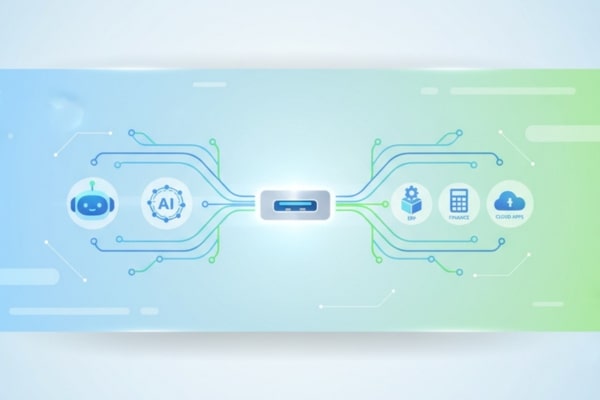
AI pilots dazzle in demos. Then reality hits: most of the work isn’t “AI”—it’s integration. Think of MCP as the USB-C for agents: a single, standard way for AI agents to find and use the business systems you already run.
MCP: Two-Sentence Brief
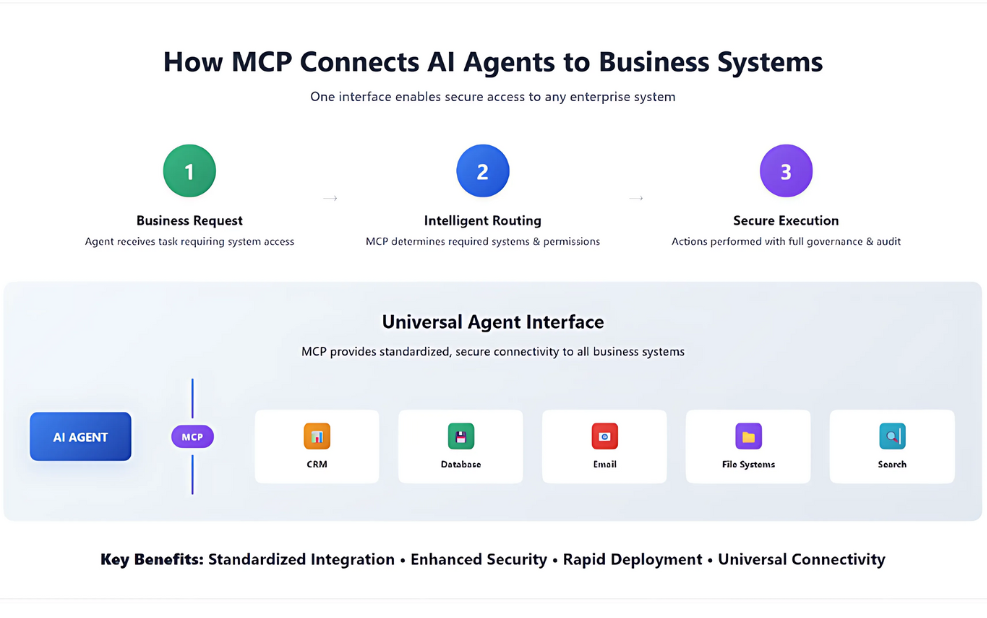
The Model Context Protocol (MCP), introduced by Anthropic, standardizes how AI agents (clients) discover and invoke tools exposed by your systems (servers). Instead of bespoke glue for every agent-to-system pairing, MCP turns integrations into a uniform contract. It is now supported across major stacks—including OpenAI’s Responses API, Microsoft’s Azure AI Foundry Agent Service, AWS, and Google DeepMind—signaling broad cross-vendor adoption.
Why MCP matters
Traditional rollouts create M×N complexity: M agents each need custom code to talk to N systems. MCP reduces that to M+N by giving agents a universal interface to governed capabilities.
Three capabilities that change the game
- Universal connectivity. One contract to reach any system you expose. Add a new PM tool or datastore and your agents can discover it—without re-coding the agent.
- Live, actionable access. Not just read-only search. Agents can read and write under guardrails—update a case, kick off a return label, move money between internal accounts—safely.
- Composable workflows. Agents chain tools based on context (not brittle scripts), adapting to exceptions without you hand-authoring every branch.
Business outcomes (numbers you can defend)
- Time-to-production: quarters → weeks (often 3–5× faster).
- Engineering mix: integration glue ~70% → ≤30% so talent shifts to differentiation.
- Onboarding new systems: weeks → hours via configuration, not code.
- Operational reliability: fewer failed actions and faster MTTR thanks to standardized retries/visibility.
Side benefit: once the integration friction drops, you can test multiple agent use cases per quarter, not one per year.
Why now
- Head start while peers unwind custom glue.
- Future-ready for next-gen models without re-wiring every integration.
- Lower lock-in by standardizing the agent interface across vendors.
What MCP is—and isn’t
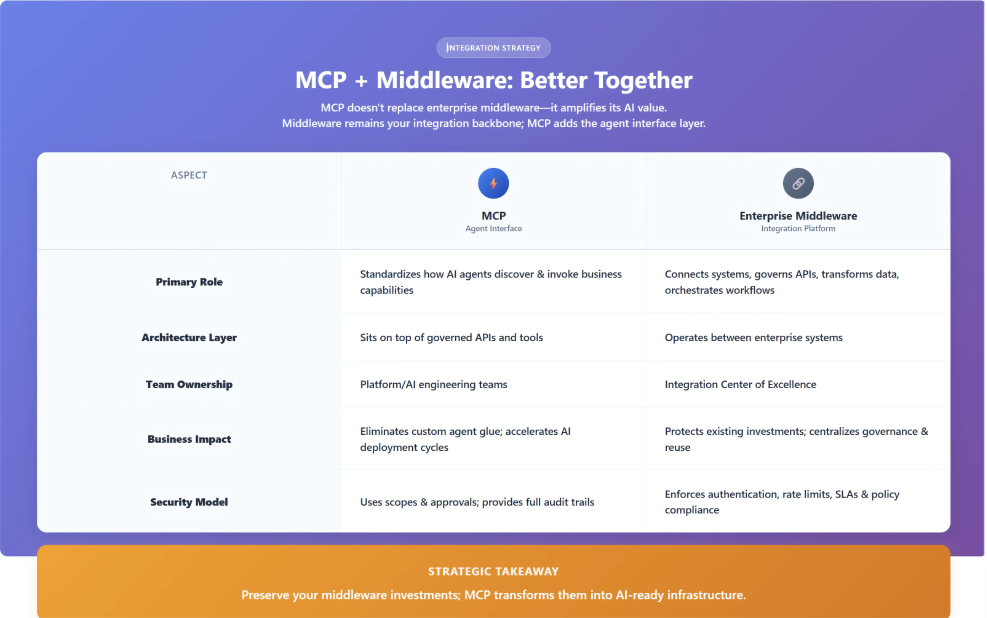
MCP standardizes how agents use governed capabilities across your stack. It works with your iPaaS/ESB (MuleSoft, Boomi)—not instead of it—and it isn’t a policy engine or autonomy switch. In practice, MCP monetizes your middleware by making those governed APIs plug-and-play for agents, cutting time-to-production.
Governance Essentials for Production-Grade AI
Run least-privilege scopes, require human approvals for destructive actions, and keep auditable logs of who did what, where, and when. Map those controls to familiar frameworks (NIST AI RMF, ISO 42001, EU AI Act record-keeping) so Legal and Audit are comfortable on day one.
A pragmatic 30/60/90 rollout plan
- Days 0–30 — Prove it. Pick one workflow with measurable value (e.g., returns, collections, onboarding). Stand up the first MCP server for your most governed API. Define scopes and logging.
- Days 31–60 — Wire three systems. Connect two more high-value systems (e.g., CRM + ERP + Support). Run dry run/shadow mode, measure lead time and error rates.
- Days 61–90 — Ship & scale. Go live with guardrails, publish the playbook (how to request new tools/scopes), and queue the next three use cases.
Success metrics to track: time-to-production, % engineering time on glue, onboarding time for a new system, failed action rate, MTTR.
The integration advantage awaits
The organizations that win the next wave of AI won’t just have better models—they’ll have faster, safer integration. MCP gives agents a common plug into the systems you already trust.
Start small, move fast: wire one workflow across three systems via MCP, cut time-to-production from a quarter to a month, then scale.