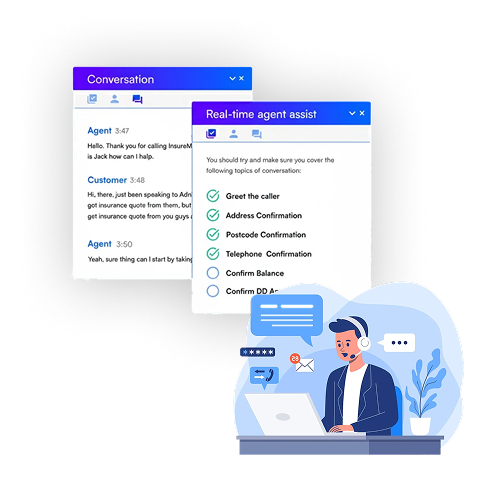

Turn a hidden cost into a competitive advantage with AI
The Hidden Time Sink in Your Contact Center
Contact center leaders often zero in on metrics like Average Handle Time, First Call Resolution, and CSAT. Yet, one of the biggest drains on productivity often goes unnoticed: After Call Work (ACW).
Agents routinely spend several minutes after each call updating records, logging summaries, assigning codes, and handling follow-ups. While this may seem like a minor task, across thousands of interactions each month, the time—and cost—becomes staggering.
For a 100-agent contact center handling 50,000 calls per month, this can translate into over $2.1 million annually spent on administrative work that doesn’t directly serve customers.
Why After Call Work Is Your Leaking Revenue Bucket
ACW includes every step an agent must complete before moving on to the next interaction. It’s especially time-consuming in sectors like finance and healthcare, where accuracy, compliance, and detailed documentation are non-negotiable.
Typical ACW tasks include:
- Updating customer profiles and internal systems
- Writing post-call summaries and resolution notes
- Assigning categories or disposition codes
- Scheduling follow-ups or escalations
- Logging compliance details such as consent or KYC information
The Business Impact of ACW
1. Slower Call Handling
Agents remain unavailable while wrapping up tasks, causing call queues to grow and service levels to drop.
2. Agent Fatigue and Burnout
Switching between customer engagement and detailed admin work adds to mental fatigue, reducing focus and morale.
3. Missed Revenue
Longer post-call times reduce daily call capacity, especially hurting teams focused on sales, retention, or upselling.
4. Compliance Risk
Manual data entry is prone to errors that compromise audit trails and regulatory obligations, especially risky in healthcare and financial services.
How AI Fixes the ACW Problem
AI offers a smarter, faster alternative to manual wrap-up work. With the right tools, contact centers can cut ACW by 60 to 80 percent—without compromising accuracy or compliance.
Here’s how AI transforms ACW:
- Automated Call Summaries: Real-time call listening enables AI to generate complete post-call notes—no typing required.
- Instant System Updates: Customer records are populated automatically during or immediately after the call.
- Smart Categorization: AI suggests appropriate call tags, case types, and next actions based on the conversation.
- Built-In Compliance: Consent, disclosures, and sensitive information are logged and stored automatically according to regulatory standards
Why PulseAI360 Leads in ACW Automation
PulseAI360 Voice Essentials is designed specifically for contact centers in regulated industries and BPOs. Our solution helps you streamline post-call work without disrupting your existing systems.
With PulseAI360, you get:
- ACW reduced from 6 minutes to under 90 seconds per call
- Automated summaries and CRM updates to eliminate manual work
- Regulatory compliance built-in for HIPAA, FDCPA, KYC, and more.
- Seamless integration with your current contact center stack
- Improved agent capacity by 15–20% and reduced supervisor workload
Your Next Step Toward Operational Efficiency
If your agents are spending minutes after every call doing manual wrap-up, you’re losing more than just time. You’re losing capacity, compliance confidence, and competitive edge.
Start by asking:
- How much time do my agents spend on After Call Work today?
- What would it mean to free up thousands of hours annually?
Let us show you how PulseAI360 can cut After Call Work by up to 80%—while maintaining full compliance and boosting agent performance. Contact us today for a personalized
Frequently Asked Questions
ACW typically includes updating CRM records, adding call notes, tagging disposition codes, scheduling callbacks, sending follow-up emails, or completing workflows.
It is a key performance metric that impacts agent productivity, overall handle time (AHT), and customer experience.
- Ensures accurate documentation so customer history is always up to date.
- Supports faster resolutions during future interactions.
- Impacts AHT and productivity, directly influencing staffing and operational costs.
- Improves compliance, especially in regulated industries like insurance, healthcare, and finance.
- Enhances customer experience by ensuring the next agent has context and no detail is lost.
- Documenting the call outcome in CRM or ticketing system.
- Adding detailed call notes with context, customer concerns, and resolution steps.
- Selecting call disposition codes for reporting and categorization.
- Triggering follow-up actions like emails, callbacks, escalations, or workflow updates.
- Updating customer profiles with new information.
- Closing the ticket or moving it to the appropriate queue (sales, claims, support, billing, etc.).
- Preparing for the next call by resetting screens and tools.
- Improved Workforce Management:Helps managers predict staffing needs accurately.
- Better Agent Productivity: Identifies workflow bottlenecks and areas for automation.
- Enhanced Quality Assurance: Ensures agents follow processes and document calls properly.
- Reduced AHT: Optimizing ACW directly lowers total handle time.
- Higher Customer Satisfaction: Ensures consistent documentation and smooth follow-up.
- Performance Coaching: Helps identify agents needing training or support.
- Foundation for Automation: Highlights areas where AI and IDP tools can reduce manual tasks.
- Global call center average: 30–90 seconds
- Technical support: 60–120 seconds
- Insurance, banking, and healthcare: 90–150 seconds (due to compliance needs)
- Sales teams: 45–90 seconds A good benchmark for most contact centers is to maintain ACW at under 60 seconds where possible, using automation to reduce manual tasks.
- Use AI call summarization to instantly generate call notes.
- Automate disposition selectionwith AI-powered tagging.
- Build guided workflows to streamline repetitive tasks.
- Integrate CRM and telephony to avoid switching between tools.
- Use templates for follow-up emails or call notes.
- Train agents on concise yet complete documentation.
- Eliminate duplicate data entry with automation tools like IDP or RPA.
- Analyze ACW reports to find outlier tasks causing delays.
ACW Formula
ACW = Total Time Spent on Post-Call Tasks ÷ Number of Calls Handled
Example:
If an agent spends 60 minutes on ACW for 80 calls:
ACW = 60 / 80 = 0.75 minutes → 45 seconds
ACW also contributes to AHT (Average Handle Time), so lowering ACW reduces AHT overall.
- Complexity of the call
- Industry regulations (e.g., insurance, healthcare)
- Number of systems/tools used
- Agent experience and skill level
- Quality of CRM integrations
- Availability of AI automation
- Workflow design
- Documentation requirements
Understanding these factors helps optimize workflows and reduce effort.
- Adopt AI-powered call wrap-up tools (summaries, auto-tagging).
- Use unified agent desktopsto reduce tool switching.
- Standardize documentation with predefined note formats.
- Use macros and snippets for repetitive tasks.
- Provide micro-training sessions to refine agent skills.
- Implement real-time QA assist to ensure accuracy.
- Reduce unnecessary fields in CRM that slow down agents.
- Review call workflows quarterly to remove redundancies.
- Inconsistent documentation across agents.
- High handle time, leading to increased queue wait times.
- Agent burnout from repetitive manual tasks.
- Tool inefficiencies and multiple system navigation.
- Compliance risks when documentation is incomplete.
- Difficulty identifying bottlenecks without proper tracking.
- Lack of automation, resulting in higher operational costs.