How manufacturers can evaluate the operational and financial impact of supply chain, procurement, and pricing changes before making decisions.
A supplier announces a 7% increase in raw material pricing.
What happens next?
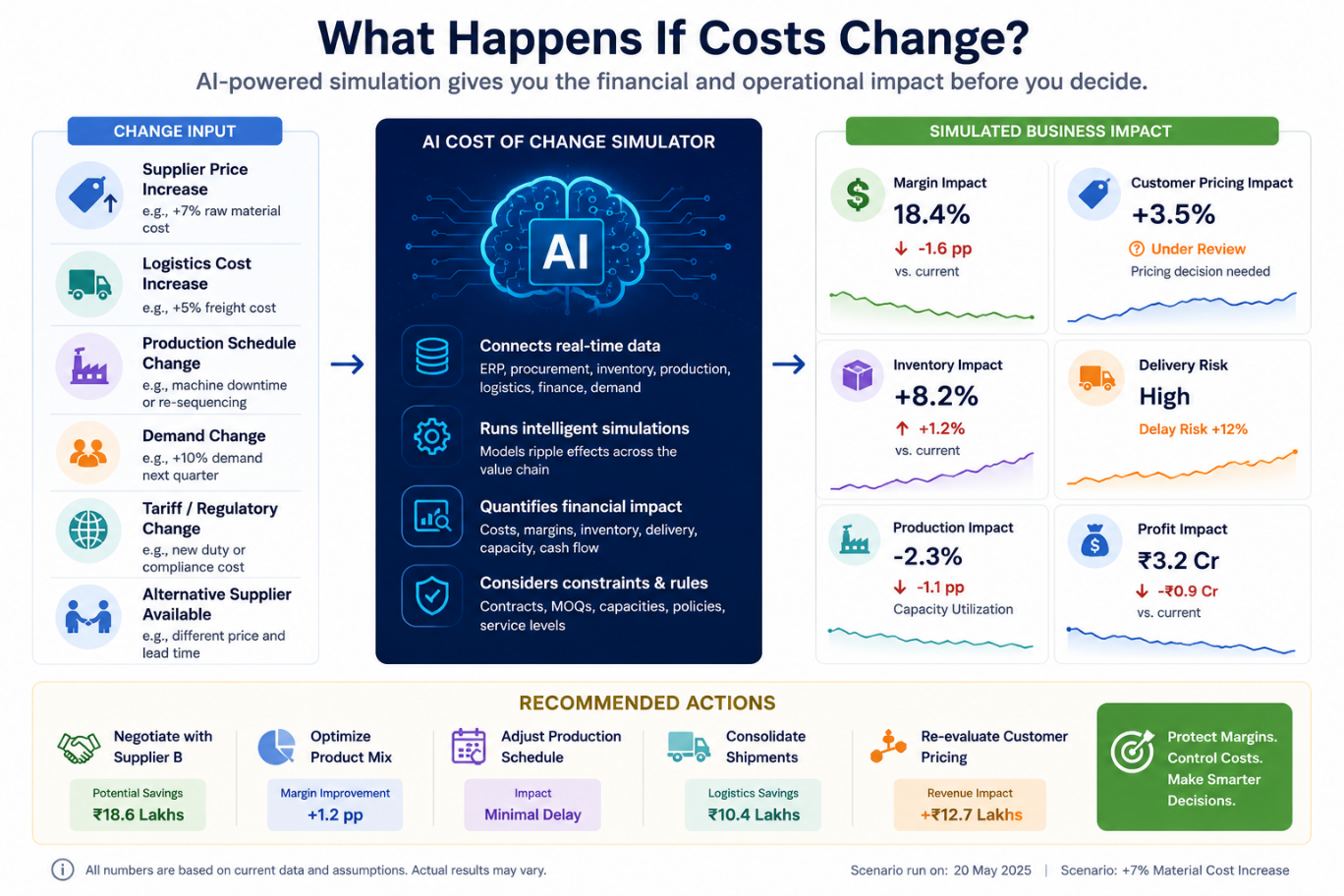
Will margins fall? Should customer prices increase? Can production be rescheduled? Is an alternative supplier more economical? What impact will the change have on inventory, delivery commitments, and profitability?
Most manufacturers cannot answer these questions immediately.
Instead, teams often rely on spreadsheets, disconnected systems, and manual analysis to estimate the impact of change. By the time decisions are made, the opportunity to respond proactively may already be gone.
Modern AI is changing this.
Supply chain leaders are increasingly shifting from reactive decision-making to more proactive, resilience-focused operating models. According to McKinsey, resilient supply chains require organizations to manage disruptions proactively rather than respond after they occur.
In this article, we’ll explore how AI-powered cost simulation enables manufacturers to evaluate the financial and operational consequences of change before it impacts the business.
Common Changes That Can Impact Manufacturing Margins
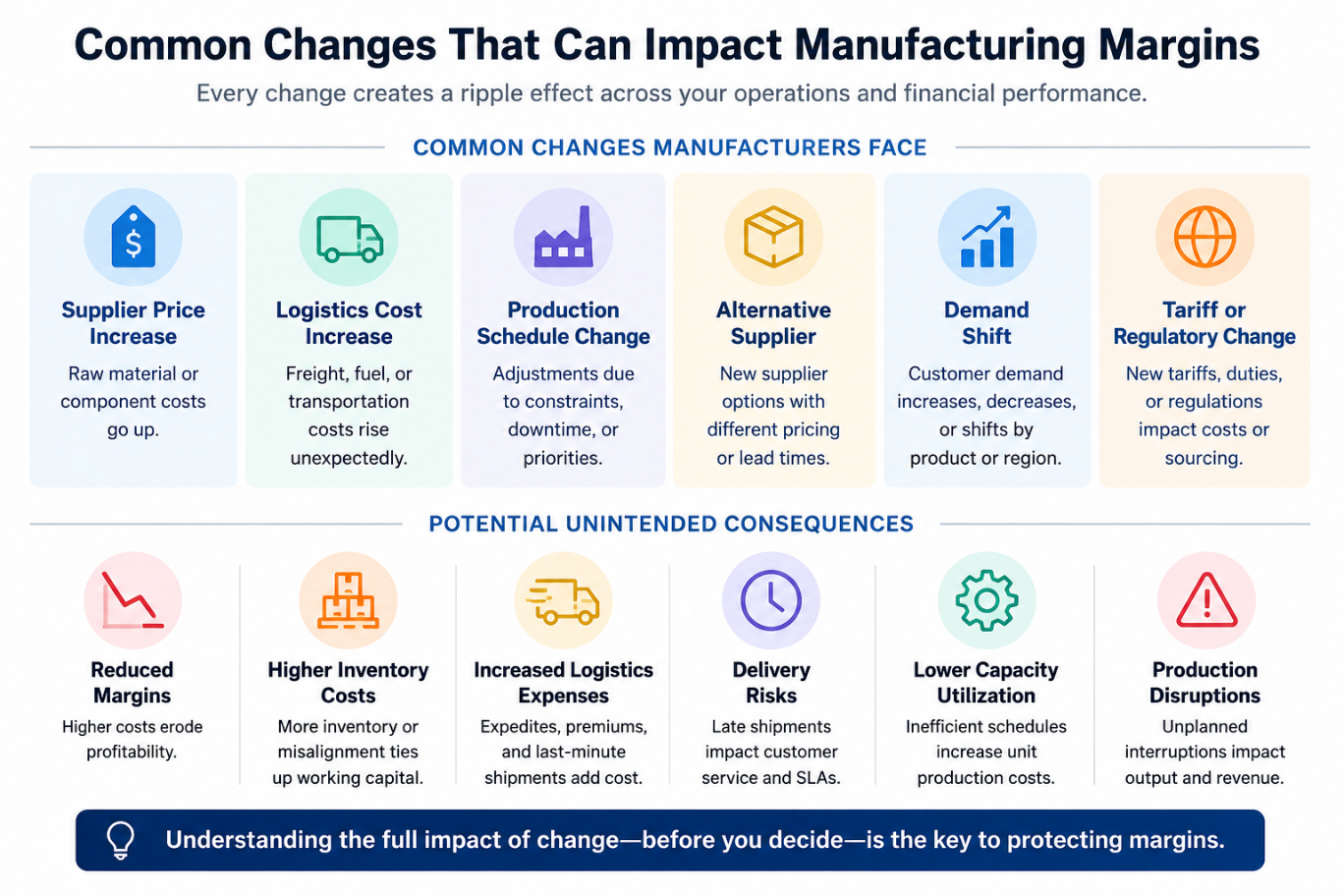
Manufacturing organizations constantly face changes that affect cost, profitability, production, and customer commitments.
Examples include supplier price increases, logistics cost increases, demand shifts, alternative sourcing decisions, production schedule changes, and tariff or regulatory changes.
While these changes may appear isolated, they often create ripple effects across the enterprise—impacting margins, inventory, production plans, customer service levels, and overall profitability.
Understanding these downstream impacts quickly enough to make informed decisions is a challenge.
Ongoing supply chain volatility continues to expose organizations to significant operational and financial risk, reinforcing the need for better visibility and faster decision-making. [McKinsey: Supply Chain Risk Survey 2024]
How AI Simulates the Cost of Change Before Decisions Are Made
Traditionally, evaluating the impact of change required spreadsheets, assumptions, and manual analysis across multiple teams.
Modern AI takes a fundamentally different approach.
By continuously analyzing operational, supply chain, and financial data, AI can simulate the downstream consequences of change before decisions are made—helping manufacturers understand how costs, margins, production, inventory, and customer commitments may be affected.
The process typically involves five steps:
- Detect the ChangeThe system continuously monitors supplier communications, procurement activities, inventory movements, logistics updates, market conditions, and demand changes.
- Correlate Affected Products, Suppliers, and CustomersOnce a change is identified, AI correlates the information with ERP and operational data to determine which products, suppliers, customers, inventory positions, and production schedules may be affected.
- Simulate Operational and Financial ImpactThe simulator then models how the change could affect key business metrics, including:
- Procurement costs
- Product margins
- Customer pricing
- Inventory levels
- Production schedules
- Delivery commitments
- Overall profitability
- Evaluate Alternative ScenariosAI then evaluates multiple response options. For example, manufacturers can compare scenarios such as:
- Negotiating with existing suppliers
- Switching to alternative suppliers
- Adjusting production schedules
- Revising customer pricing
- Changing product mix
Each scenario is assessed based on cost, risk, service impact, and profitability.
- Recommend Optimal ActionsFinally, the system provides decision-makers with recommended actions and projected outcomes, enabling teams to select the response that best protects margins, minimizes disruption, and supports business objectives.
A Worked Example: Responding to a Raw Material Price Increase
Consider a common manufacturing scenario.
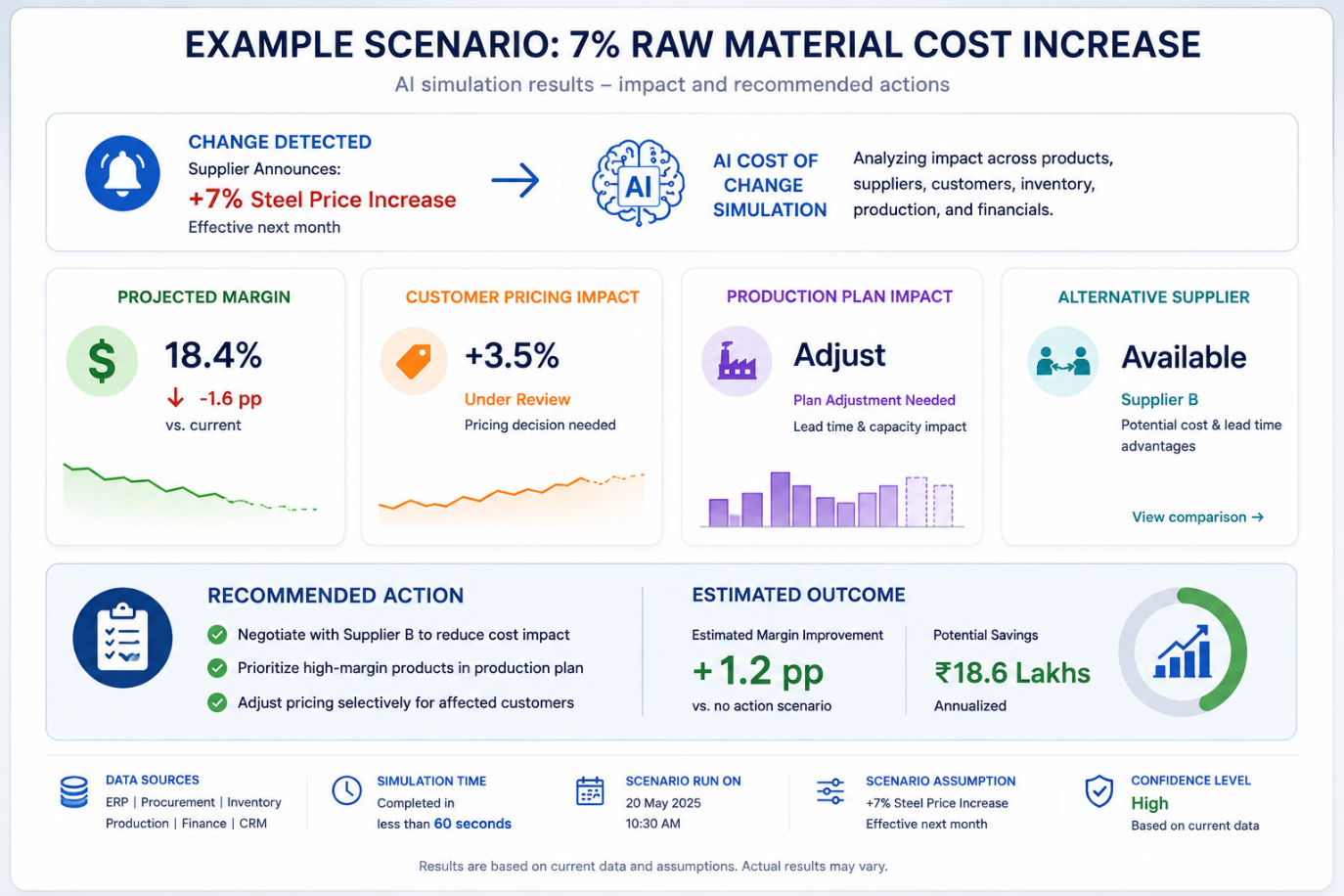
A key supplier informs the procurement team that steel prices will increase by 7% effective next month.
Traditionally, evaluating the impact of this change requires multiple teams working across spreadsheets, emails, and disconnected systems—often taking days or even weeks.
An AI-powered Cost of Change Simulator dramatically accelerates this process. As soon as the price increase is identified, AI automatically correlates the change with affected products, customer orders, inventory positions, production schedules, and supplier contracts.
The simulator can then answer critical questions such as:
- Which products will be affected?
- How much will product margins decline?
- Should customer pricing be adjusted?
- Can an alternative supplier reduce the impact?
- Can production plans be optimized to protect profitability?
The system evaluates multiple response scenarios, quantifies the operational and financial impact of each option, and recommends actions that best protect margins while minimizing disruption.
Instead of reacting after profitability has already been affected, manufacturers can make informed decisions proactively.
Do Manufacturers Already Have the Data Needed for Cost Simulation?
Yes.
Most manufacturers already possess the information required to evaluate the operational and financial impact of change.
The challenge is not a lack of data. The challenge is that critical information is typically scattered across ERP systems, procurement applications, spreadsheets, supplier communications, logistics updates, inventory systems, and financial records.
As a result, understanding the true impact of change often requires manual analysis across multiple teams and disconnected data sources.
Modern AI addresses this challenge. Platforms such as
DocuVera360 by Trellissoft
can continuously ingest, understand, and correlate operational, financial, and supply chain information—enabling manufacturers to simulate change scenarios using the data they already possess.
Importantly, manufacturers do not need to replace existing ERP or operational systems to begin improving decision-making. Modern AI platforms operate as non-invasive intelligence layers that extend existing investments while preserving established business processes.
Deloitte describes how digital supply networks transform disconnected, linear supply chains into connected ecosystems that enable better decision-making, improved visibility, and greater resilience.
Business Benefits of AI-Powered Cost Simulation
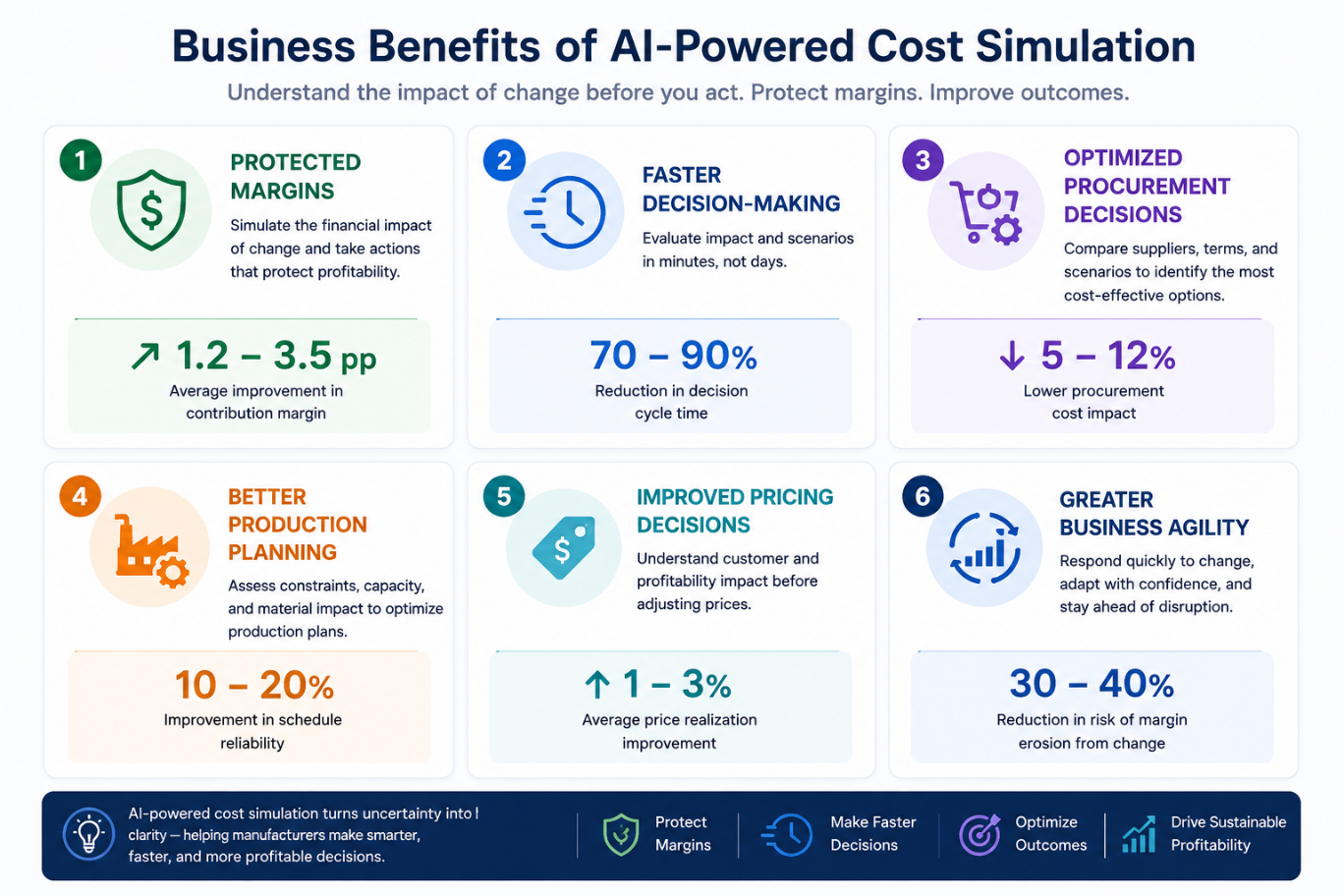
The real value of AI-powered cost simulation lies in its ability to improve both operational and financial performance.
By understanding the downstream impact of change before decisions are made, manufacturers can respond more confidently, protect profitability, and reduce the risk of unintended consequences.
Protect Margins Before Change Impacts Your Business
This article is part of a four-part series: Four AI-Powered Capabilities Transforming Manufacturing Operations.
→ Read the pillar article for an overview of all four capabilities.
→ Previous: From Firefighting to Foresight: Improving Manufacturing Forecast Accuracy with AI
Discover how DocuVera360 by Trellissoft helps manufacturers simulate the operational and financial impact of change, protect margins, and make faster, more informed decisions.
Schedule a personalized demonstration or an Enterprise Data Readiness Assessment with Trellissoft.