A CASE STUDY
Redefining Cardiology Intelligence via Scalable RPM Data Architecture
Industry
Healthcare
Domain
Data Engineering & Analytics
Executive
Executive Summary
A leading cardiac healthcare technology provider engineered a lightweight, continuous wearable ECG patch designed to replace traditional, short-duration diagnostic tools. However, capturing continuous physiological data over extended periods introduced a severe secondary challenge: translating massive streams of unformatted rhythm data into actionable clinical insights. The client faced critical visibility gaps, restricted by episodic reporting workflows and an inability to sustain continuous rhythm surveillance across outpatient settings.
To bridge this diagnostic gap, Trellissoft partnered with the organization to architect a robust, cloud-connected software ecosystem. By establishing a single source of truth for patient cardiology data, Trellissoft reclaimed thousands of hours previously lost to manual review and consolidated disparate diagnostic streams. This integrated architecture eliminated the data fragmentation that plagued legacy workflows, enabling clinicians to seamlessly process multi-day rhythm information, optimize care delivery, and detect intermittent arrhythmias with unprecedented precision.
01
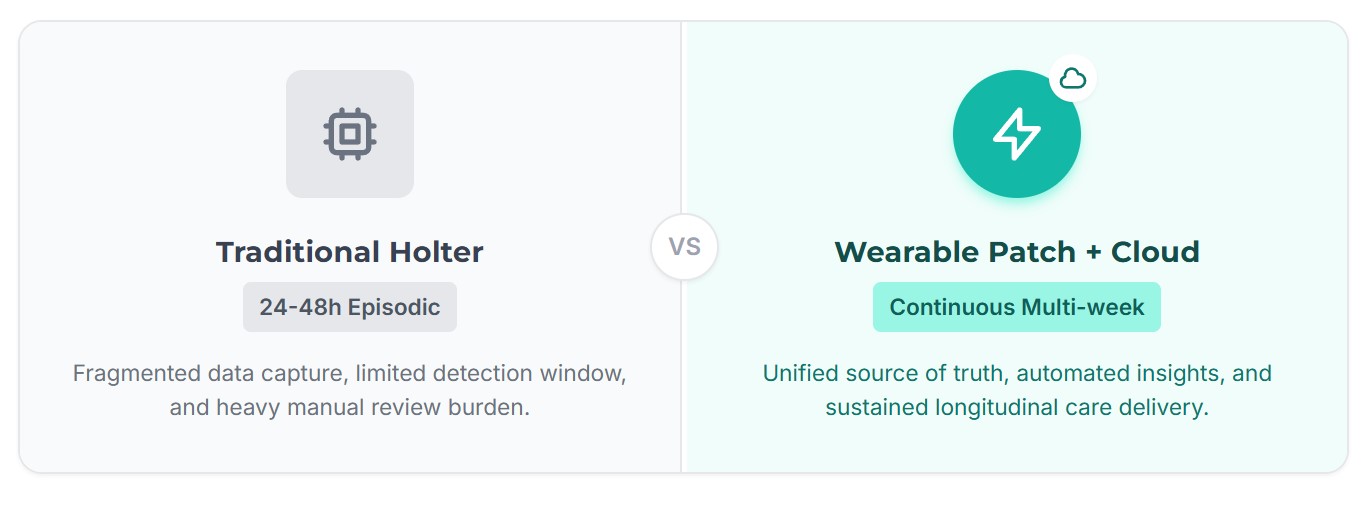
24–48h Episodic
Traditional Holter
Fragmented data capture, limited detection window, and heavy manual review burden.
VS
02
Continuous Multi-week
Wearable Patch + Cloud
Unified source of truth, automated insights, and sustained longitudinal care delivery.
The Challenge
Data Fragmentation and Manual Heroics
Historically, cardiology departments have depended on episodic diagnostic tools—such as 12-lead ECGs and 24–48 hour Holter monitors—that capture exceptionally narrow windows of cardiac activity. Relying on these short-duration tests forced clinical teams into “manual heroics,” piecing together disjointed data fragments in an attempt to diagnose intermittent arrhythmias. This fragmented approach fundamentally restricted the ability to execute population-level remote patient monitoring (RPM) without dramatically increasing administrative overhead and clinical burden.
Furthermore, organizations lacked the necessary scalable infrastructure to sustain continuous rhythm surveillance across multi-day or multi-week periods within an outpatient setting. Unlike general-purpose home sleep testing platforms designed for short diagnostic windows, cardiology demands a sustained, specialized framework.
Key Friction Points
Diagnostic Visibility Gaps
Short-duration diagnostic windows routinely resulted in missed detection of intermittent conditions, such as paroxysmal atrial fibrillation, which may go completely undetected if an event fails to occur during the brief testing period.
Workflow Bottlenecks
Heavy dependence on in-clinic workflows restricted monitoring solely to patients who could physically attend appointments, creating unsustainable workloads for care teams attempting to scale their RPM panels.
Revenue Inconsistency
Fragmented billing structures remained strictly tied to individual, episodic test events, which hindered predictable revenue generation and practice growth for cardiology providers.
The Challenge
Data Fragmentation and Manual Heroics
Historically, cardiology departments have depended on episodic diagnostic tools—such as 12-lead ECGs and 24–48 hour Holter monitors—that capture exceptionally narrow windows of cardiac activity. Relying on these short-duration tests forced clinical teams into “manual heroics,” piecing together disjointed data fragments in an attempt to diagnose intermittent arrhythmias. This fragmented approach fundamentally restricted the ability to execute population-level remote patient monitoring (RPM) without dramatically increasing administrative overhead and clinical burden.
Furthermore, organizations lacked the necessary scalable infrastructure to sustain continuous rhythm surveillance across multi-day or multi-week periods within an outpatient setting. Unlike general-purpose home sleep testing platforms designed for short diagnostic windows, cardiology demands a sustained, specialized framework.
Key Friction Points
Diagnostic Visibility Gaps
Short-duration diagnostic windows routinely resulted in missed detection of intermittent conditions, such as paroxysmal atrial fibrillation, which may go completely undetected if an event fails to occur during the brief testing period.
Workflow Bottlenecks
Heavy dependence on in-clinic workflows restricted monitoring solely to patients who could physically attend appointments, creating unsustainable workloads for care teams attempting to scale their RPM panels.
Revenue Inconsistency
Fragmented billing structures remained strictly tied to individual, episodic test events, which hindered predictable revenue generation and practice growth for cardiology providers.
The Solution
Engineered for a Single Source of Truth
To overcome these critical operational bottlenecks and close the diagnostic gap, Trellissoft engineered a vertically integrated data platform tailored specifically for complex cardiology workflows. Key pillars of the solution include:
Continuous Surveillance
Pivoted from isolated snapshots to a dynamic “Single Source of Truth” supporting uninterrupted, longitudinal cardiac surveillance.
Automated Ingestion
Technical architecture seamlessly ingests continuous, all-beat rhythm capture directly from wearable ECG patches without requiring manual patient activation.
ETL Pipelines & EDW
Integrated advanced, automated ETL routing physiological telemetry into a centralized, HIPAA-aligned Enterprise Data Warehouse (EDW).
Advanced BI & EHR Integration
Raw datasets are transformed and securely pushed to Power BI/Tableau, embedding structured rhythm insights directly into ordering cardiologists’ clinical portals.
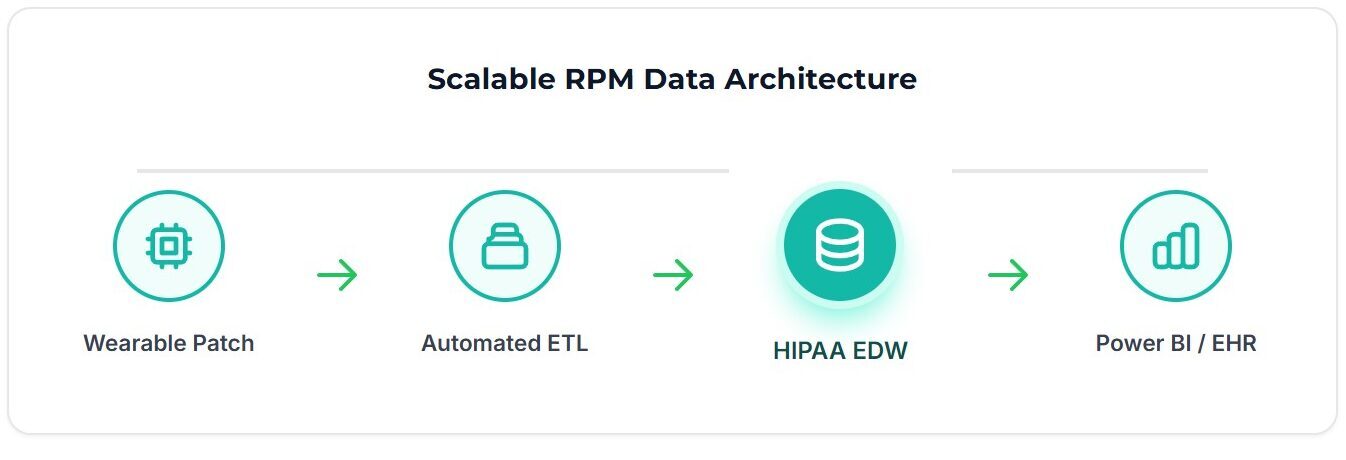
Scalable RPM Data Architecture
Wearable Patch
Automated ETL
HIPAA EDW
Power BI / EHR
The Results
|
Metric
|
Before Integration
|
After Integration
|
|---|---|---|
|
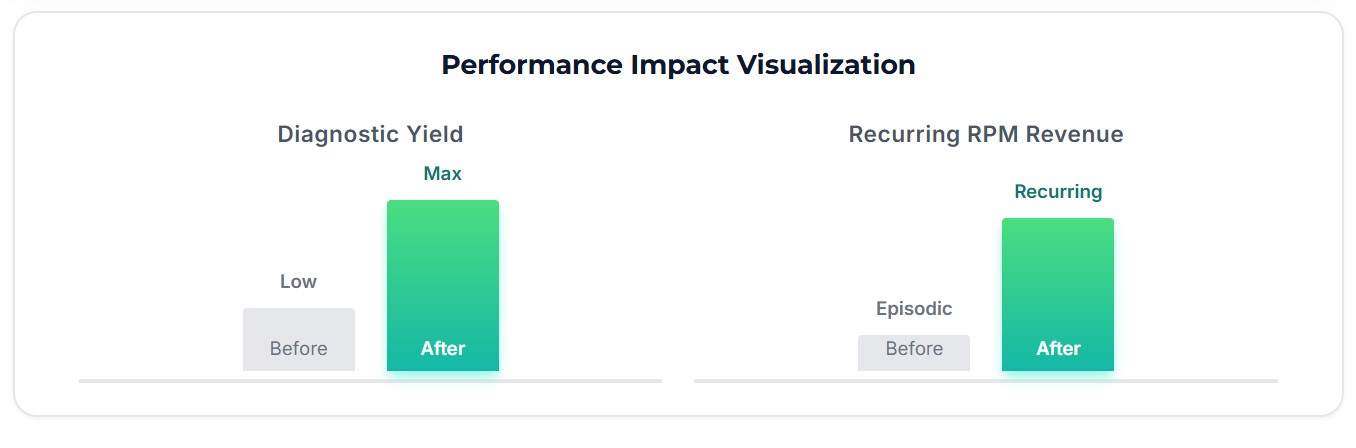
Diagnostic Yield
|
Episodic diagnostics led to frequent missed detection windows for paroxysmal atrial fibrillation and intermittent events.
|
Uninterrupted ECG capture across multi-day monitoring significantly improved automated arrhythmia detection rates.
|
|
Care Team Workload
|
Heavy reliance on restrictive in-clinic visits and manual patient activation for event-recorder monitoring.
|
Asynchronous clinical review and remote onboarding optimized throughput without proportional administrative staff increases.
|
|
Revenue Model
|
Inconsistent income generated on a restrictive study-by-study, episodic per-test billing basis.
|
Scalable, recurring RPM revenue tied to ongoing patient enrollment, extended wear times, and monthly monitoring.
|
"By consolidating fragmented ECG streams into a centralized data warehouse, we engineered a single source of truth that empowers cardiology practices to reclaim clinical visibility, decisively shifting their operational posture from reactive episode management to proactive, scalable, and continuous longitudinal care."