A CASE STUDY
AI-DRIVEN MODERNIZATION AT SCALE
Legacy Application Transformation at Enterprise Scale Using AI
Industry
Manufacturing
Domain
Data Engineering & Analytics
Executive Summary
We transformed 160+ legacy .NET 4.x applications into modern .NET 10 Blazor and WinApp/WPF platforms. By embedding enterprise AI tools across the entire software delivery lifecycle, we established a repeatable modernization factory—accelerating delivery, reducing risk, and dramatically improving engineering productivity.
160+
Legacy applications modernized at scale
40–50%
Faster delivery using accelerated execution models
30–45%
Engineering productivity lift via AI enablement
Client Overview
The client operates a broad enterprise application landscape consisting of more than 160 business-critical legacy applications developed over time on older Microsoft technology stacks. These applications support a mix of operational, departmental, and business workflows and include both web based and desktop-based systems.
As business needs evolved, the client required a structured modernization program to move away from aging frameworks, improve maintainability and supportability, standardize application architecture, increase developer productivity, and prepare the portfolio for future innovation.
TARGET TECHNOLOGY PROFILE
.NET 10 Ecosystem
Blazor Web Applications
WinApp / WPF Desktop
CORE AI CAPABILITIES
AI-Assisted Discovery
Automated Refactoring
AI Copilot Development
Automated QA & Testing
Business Challenge
The client faced several challenges typical of large legacy estates. The modernization program was not limited to a simple technical upgrade. It required a strategic replatforming approach that could assess each application, determine the most suitable future state, and execute migrations efficiently at scale.
"With 160+ applications, traditional one-by-one migration methods would be time-consuming, inconsistent, and expensive. The client needed a repeatable factory-based modernization model to handle the diverse application portfolio."
Aging Technology Landscape
A significant number of applications were running on .NET Framework 4.x, making them harder to maintain, enhance, and align with modern engineering practices.
Diverse Portfolio
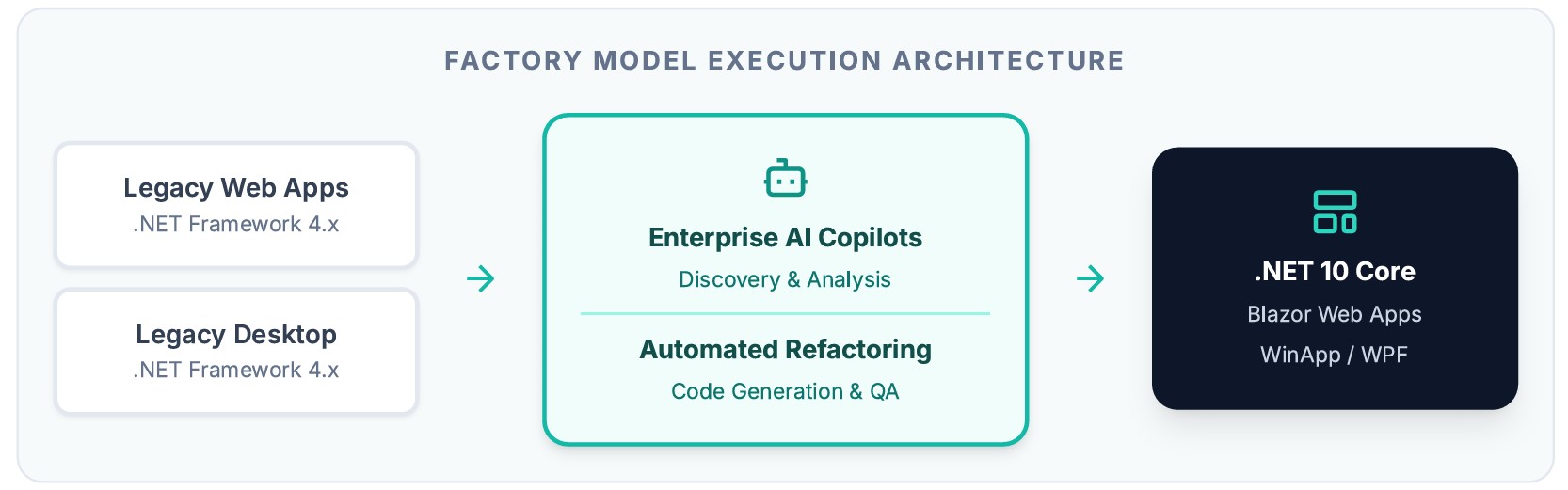
The estate included both web and desktop applications, requiring different modernization paths such as migration to Blazor and WinApp/WPF while standardizing on .NET 10.
High Discovery Effort
Many legacy applications had limited documentation, tightly coupled code, and hidden dependencies. Understanding the current state required significant effort.
Speed vs. Quality
The client needed to accelerate modernization without increasing delivery risk, regression issues, or UAT delays across their massive software portfolio.
AI-Driven Application Modernization
We designed and executed an AI-driven application modernization approach that embedded enterprise AI tools across the end-to-end delivery lifecycle. Each application was assessed and aligned to an appropriate target state with standardized architecture.
Implementation Highlights
1
Portfolio-Based Planning
Applications were grouped and assessed based on technical complexity, business priority, and target-state suitability to determine the right migration path.
2
Dual Modernization Tracks
The implementation supported both web modernization using Blazor and desktop modernization using WinApp/WPF, while keeping .NET 10 as the common baseline.
3
AI Embedded Across SDLC
AI was integrated into discovery, requirements, design, architecture, development, testing, and UAT preparation.
4
Standardized Engineering Patterns
The team established reusable patterns for project setup, coding conventions, migration approach, architecture decisions, and delivery governance.
5
Faster Proof-of-Concept Cycles
AI-supported prototyping reduced the time needed to validate framework choices and migration feasibility before broader rollout.
AI-Powered Delivery Model
AI tools were deployed as accelerators across every phase of delivery, fundamentally shifting how the engineering teams executed the modernization lifecycle.
Discovery & Code Analysis
AI-assisted scanning helped teams analyze codebases, identify patterns, understand dependencies, and speed up legacy system comprehension.
Solution Design
AI was used to accelerate requirement interpretation, gap analysis, and solution blueprinting, helping teams align faster on scope and design.
Architecture & Frameworks
AI supported the creation of modern application scaffolding, architectural decision support, and framework-level setup for Blazor and desktop paths.
Development & Refactoring
Embedded AI copilots helped accelerate code conversion, refactoring, repetitive implementation work, and application of modernization patterns.
Rapid POC & R&D
AI-assisted prototyping enabled faster validation of migration approaches, architecture decisions, and technical feasibility before scale.
QA Support & UAT
AI-generated test scenarios, validation support, and documentation assistance helped prepare applications for testing and user acceptance efficiently.
Modernization Results
|
Area
|
Traditional Approach
|
AI-Driven Outcome
|
Outcome
|
|---|---|---|---|
|
Legacy discovery
|
Manual code analysis & dependency review
|
AI-assisted code scanning & pattern recognition
|
Faster application understanding
|
|
Requirement analysis
|
Time-intensive manual interpretation
|
AI-accelerated requirement & gap analysis
|
Quicker alignment on scope and design
|
|
Architecture setup
|
Repeated manual setup effort
|
AI-guided scaffolding & framework setup
|
Faster project initiation
|
|
Dev & refactoring
|
Manual rewrite and repetitive coding
|
AI-assisted code generation & modernization support
|
Higher developer productivity
|
|
POC / tech validation
|
Longer experimental cycles
|
AI-powered rapid prototyping
|
Faster de-risking of approach
|
|
Testing & UAT readiness
|
Manual test preparation and
validation
|
AI-generated test support & validation assets
|
Improved UAT preparedness
|
|
Delivery speed
|
Conventional migration timelines
|
Accelerated execution model
|
40–50% faster delivery
|
|
Engineering productivity
|
Standard productivity baseline
|
AI-enabled developer acceleration
|
30–45% productivity lift
|
|
Portfolio execution
|
App-by-app migration
|
Repeatable modernization factory
|
Scalable for 160+ applications
|
EXECUTIVE OUTCOME
"The modernization initiative proved that enterprise AI can be used not just as a coding assistant, but as a strategic accelerator for larg -scale application transformation."
Integrating .NET 10 architectures (Blazor, WinApp/WPF) with AI-powered delivery practices fundamentally accelerated the transition from legacy to modern platforms. This synergistic approach slashed engineering effort, boosted developer productivity, and fast-tracked UAT readiness across a massive application estate.
Ultimately, the client secured a scalable “modernization factory” model. This repeatable framework not only conquered immediate technical debt but forged a resilient, highly maintainable foundation to power all future digital transformation waves.