
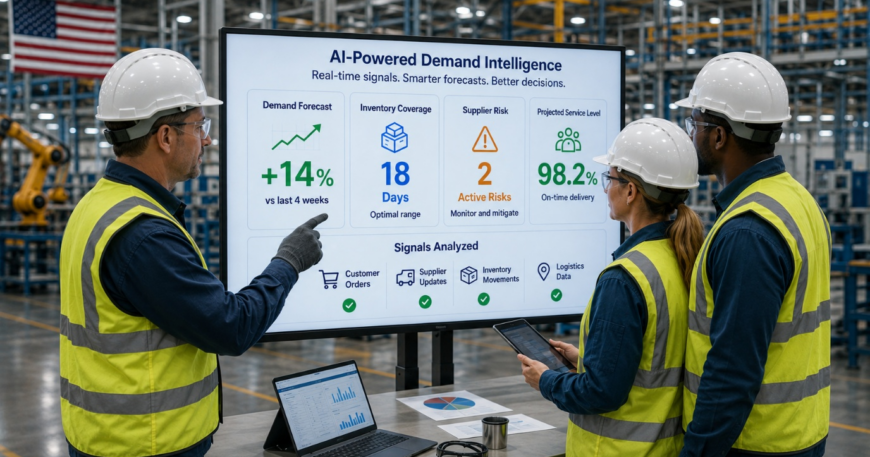
How manufacturers can improve forecast accuracy and respond faster to change using AI-powered demand sensing.
Forecasting sits at the center of manufacturing operations. Production schedules, procurement decisions, inventory targets, and customer commitments all depend on the ability to accurately predict future demand.
For decades, manufacturers relied on historical sales data, periodic planning cycles, and ERP-based forecasting tools to guide operational decisions. In relatively stable markets, this approach was often sufficient.
Today’s manufacturing environment is far less predictable.
Customer demand shifts rapidly. Supply chain disruptions occur with little warning. Lead times fluctuate. Market conditions change continuously. As a result, forecasts can become outdated long before the next planning cycle begins.
Modern AI solves this problem. AI forecasting technologies—particularly AI-powered demand sensing—are transforming how manufacturers predict demand and respond to change.
AI Forecasting Delivers Measurable Results
- 20–50% – Reduction in forecast errors with AI-driven forecasting.
- Up to 65% – Reduction in lost sales and product unavailability.
- 5–10% – Reduction in warehousing costs.
By combining intelligent document processing with AI-powered demand sensing, manufacturers can move beyond static forecasts and create a continuously updated view of demand. Instead of relying solely on historical trends, organizations can respond dynamically to changing conditions, improve forecast accuracy, and make more informed operational decisions.
In this article, we’ll explore how AI-powered demand sensing is transforming manufacturing forecasting—and helping manufacturers plan with greater confidence.
What Is Demand Sensing in Manufacturing?
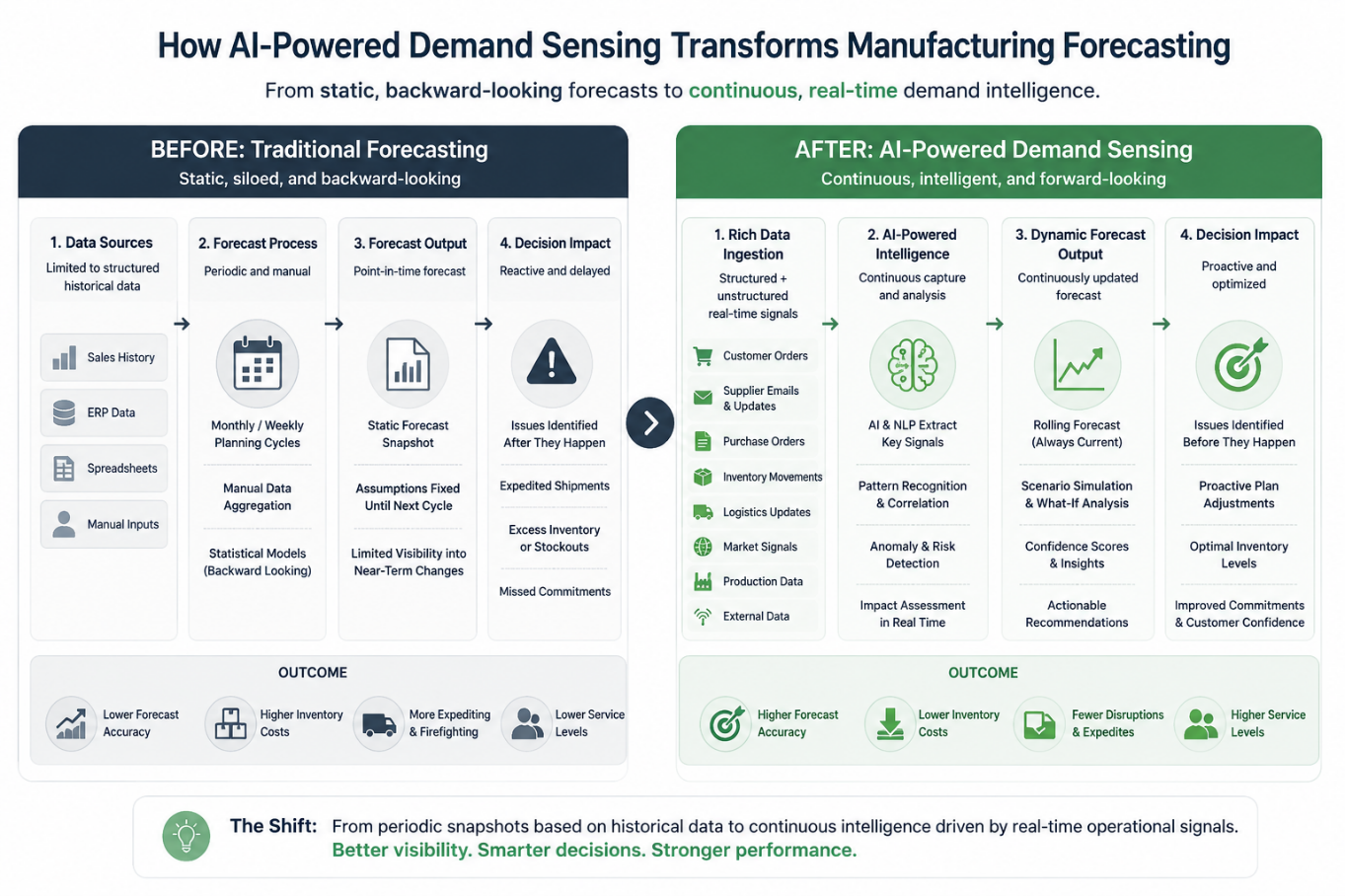
Demand sensing is an AI-driven approach to forecasting that incorporates real-time operational signals to improve forecast accuracy and enable more responsive planning.
Unlike traditional forecasting, it does not rely solely on historical sales data and periodic planning cycles. Demand sensing utilizes machine learning to continuously analyze a broad range of signals from across the enterprise—including customer orders, supplier updates, inventory movements, logistics data, and market activity.
This method enables manufacturers to improve agility and optimize inventory levels. Learn more about these capabilities in the ASCM Digital Capability Framework.
The result is a manufacturing forecasting process that is more accurate, agile, and aligned with real-world operating conditions—enabling manufacturers to respond faster to disruptions, optimize inventory levels, and make more informed operational decisions.
How Manufacturers Are Enabling Demand Sensing
Manufacturers are increasingly combining intelligent document processing, enterprise integrations, and AI analytics to capture demand signals from across the business. Solutions such as Trellissoft’s DocuVera360 help organizations unlock insights hidden within supplier emails, purchase orders, logistics updates, and other operational documents—without disrupting existing ERP environments.
What Are the Business Benefits of AI-Powered Demand Sensing?
The real value of AI-powered demand sensing lies in its ability to improve operational and financial performance across the manufacturing enterprise.
Manufacturers can now create forecasts that better reflect actual market conditions and reduce reliance on outdated assumptions.
More accurate forecasts deliver substantial operational and financial benefits across the manufacturing enterprise.
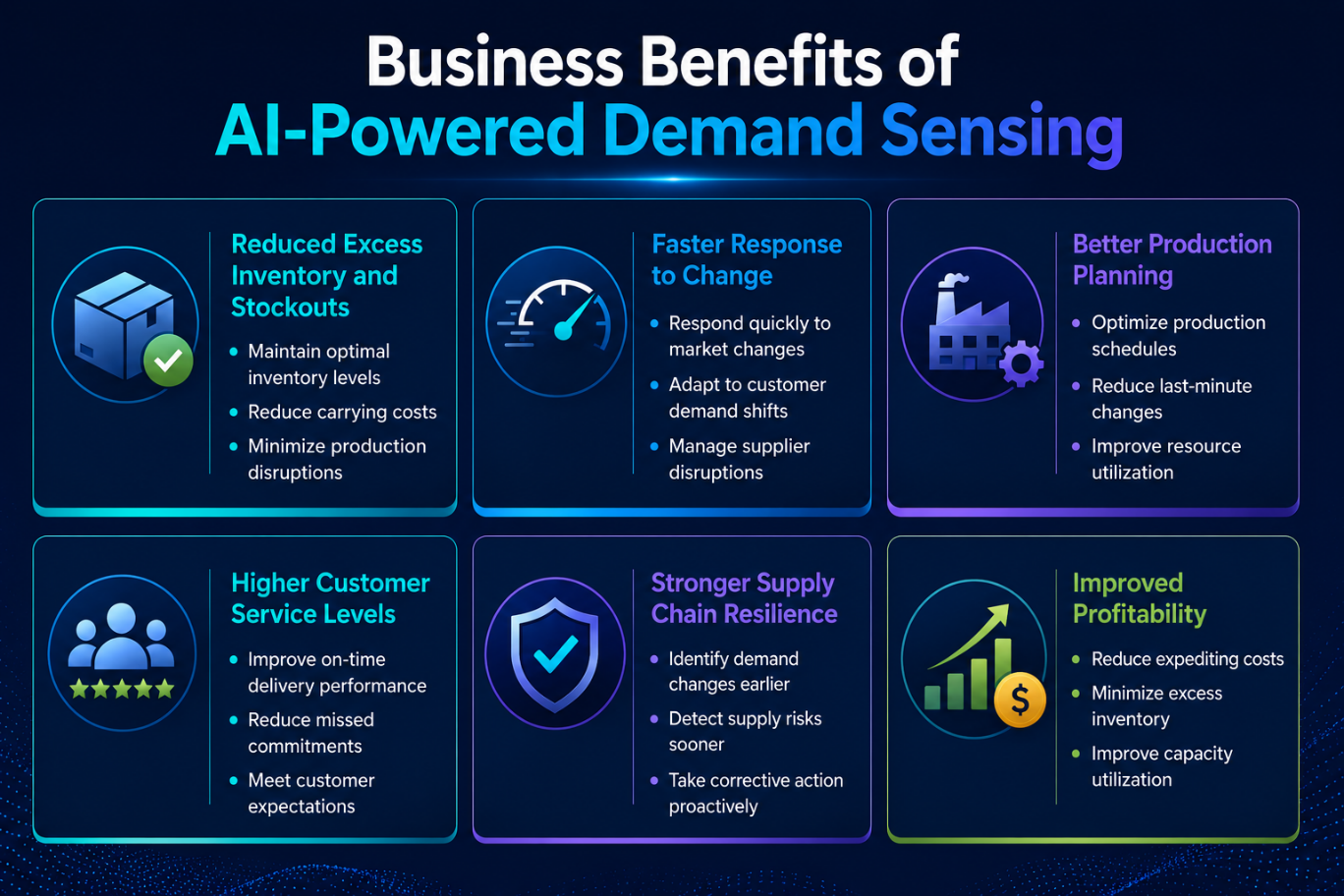
AI-powered demand sensing improves manufacturing performance by utilizing real-time signals to enhance forecast accuracy and transition from reactive to proactive, agile operations. Integrating automated, touchless forecasting reduces reliance on outdated assumptions and drives substantial operational efficiency. [Gartner]
Real-World Demand Sensing Use Cases
AI-powered demand sensing is already helping manufacturers improve forecasting accuracy, anticipate disruptions, and make better operational decisions across diverse industries.
Example 1: Improving Spare Parts Forecast Accuracy
A spinning textile machinery manufacturer struggled to accurately predict demand based on twelve years of historical sales information.
The challenges:
- Forecast accuracy remained between 45% and 50%
- More than 4,000 SKUs had to be managed across multiple product categories.
- Inventory shortages frequently forced planners to manually reprioritize production schedules.
- Forecasts were largely based on historical trends and periodic planning cycles.
By introducing AI-powered demand sensing, the manufacturer can create a continuously updated forecasting process that combines historical demand patterns with current operational signals.
The proposed solution includes:
- Weekly and monthly forecasts for a rolling three-month planning horizon.
- A target forecasting accuracy of 80% to 85%
- Variance analysis explaining differences between forecasted and actual demand.
- Exception alerts identifying supplier delays, inventory shortages, and emerging production risks before they impacted customer commitments.
Instead of reacting to shortages after they occurred, planners would be able to proactively adjust procurement, production schedules, and inventory policies based on predicted demand shifts.
Example 2: AI-Driven Agricultural Production Forecasting in the Sugar Industry
Unlike traditional manufacturing environments, sugar production depends heavily on external variables such as weather patterns, crop yields, and harvesting conditions.
The organization needs to forecast:
- Total acreage requiring plantation for the upcoming financial year.
- Expected sugarcane crushing volumes.
- Seasonal rainfall patterns affecting crop yield and harvesting schedules.
Using AI-powered demand sensing, the company could combine multiple sources of information, including:
- Historical plantation and crushing data.
- Rainfall and weather records.
- Soil and regional agronomic data.
- Current crop conditions and field reports.
- External meteorological forecasts.
AI models continuously evaluate these signals to generate forecasts and recommendations such as:
- Adjusting plantation targets to mitigate anticipated shortfalls.
- Identifying regions at risk from insufficient rainfall.
- Recommending alternate sourcing or procurement strategies.
- Optimizing crushing schedules and capacity utilization.
- Highlighting potential production risks early enough for corrective action.
This approach transforms planning from a largely experience-driven process into a data-driven, predictive decision framework.
Sounds great, but do we need to replace our ERP?
Can Manufacturers Improve Forecasting Without Replacing Their ERP?
Yes.
Modern AI platforms operate as a non-invasive intelligence layer on top of existing systems, enabling manufacturers to modernize incrementally rather than pursue large-scale replacement initiatives, an approach increasingly recommended in application modernization strategies (Source: IBM) .
Rather than replacing ERP, AI continuously analyzes operational signals from across the enterprise and feeds actionable insights into existing planning workflows.
This approach enables manufacturers to:
- Preserve existing ERP investments
- Improve forecasting incrementally rather than through large-scale transformation projects
- Accelerate time-to-value
- Minimize operational disruption
- Extend AI-powered forecasting capabilities without changing core business processes
Platforms such as Trellissoft’s DocuVera360 make this possible by combining intelligent document processing with AI-powered analytics to transform operational information into decision-ready intelligence.
Manufacturers can begin with a single process, product line, or business unit and expand adoption over time—delivering immediate value while laying the foundation for broader AI-driven planning capabilities.
Moving Beyond Static Forecasts
This article is part of a four-part series: Four AI-Powered Capabilities Transforming Manufacturing Operations.
→ Read the pillar article for an overview of all four capabilities.
→ Next: Demand Sensing — Moving Beyond Traditional Forecasting
This article is part of a four-part series: Four AI-Powered Capabilities Transforming Manufacturing Operations.
→ Read the pillar article for an overview of all four capabilities.
→ Previous: Early Warning System: Using AI to Detect Supply Chain Risks Before Production Stalls
Ready to modernize manufacturing forecasting?
Discover how Trellissoft’s DocuVera360 transforms operational documents, supplier communications, and business data into real-time demand intelligence.