
Most supply chain disruptions don’t occur without warning—they occur when early warning signs go unnoticed. Here’s how AI changes that.
Most supply chain disruptions don’t announce themselves through an ERP alert.
They first appear as a supplier email mentioning a delivery delay. A logistics update flagging port congestion. A purchase order amendment quietly changing a delivery term. A material certificate approaching expiry.
The warning is there—but it’s buried in documents, emails, and operational updates that no one is monitoring closely enough.
This is the first article in our four-part series exploring the AI capabilities featured in our pillar article, Four AI-Powered Capabilities Transforming Manufacturing Operations. Here, we examine AI-powered early warning—how it works, why traditional risk monitoring falls short, and how manufacturers can implement it without replacing existing systems.
Why Traditional Risk Monitoring Falls Short
Most procurement and supply chain teams are not short of information. They receive supplier status updates, logistics notifications, quality alerts, and purchase order changes continuously.
Operational signals rarely surface as structured ERP exceptions. Instead, they appear as:
- “Shipment delayed due to port congestion.”
- “Raw material availability constrained until next month.”
- “Production capacity reduced because of equipment maintenance.”
Extracting meaningful risk intelligence from language like this — and then connecting it to live inventory levels, open purchase orders, and production schedules — is beyond what manual review processes can reliably sustain.
Traditional methods carry real limitations:
- They depend on individuals to recognize and escalate risks quickly enough
- Risk signals arrive in unstructured formats that don’t appear in dashboards
- No single person monitors every relevant inbox, document stream, or logistics feed
- By the time the risk is escalated, the response window has already narrowed
The result is a reactive organization — not because people aren’t working hard enough, but because the information architecture makes proactive monitoring structurally difficult.
Building more resilient supply chains increasingly requires systematic risk identification, assessment, and mitigation across the extended supplier ecosystem. ASCM supply chain risk management guidance provides a useful framework for understanding these practices.
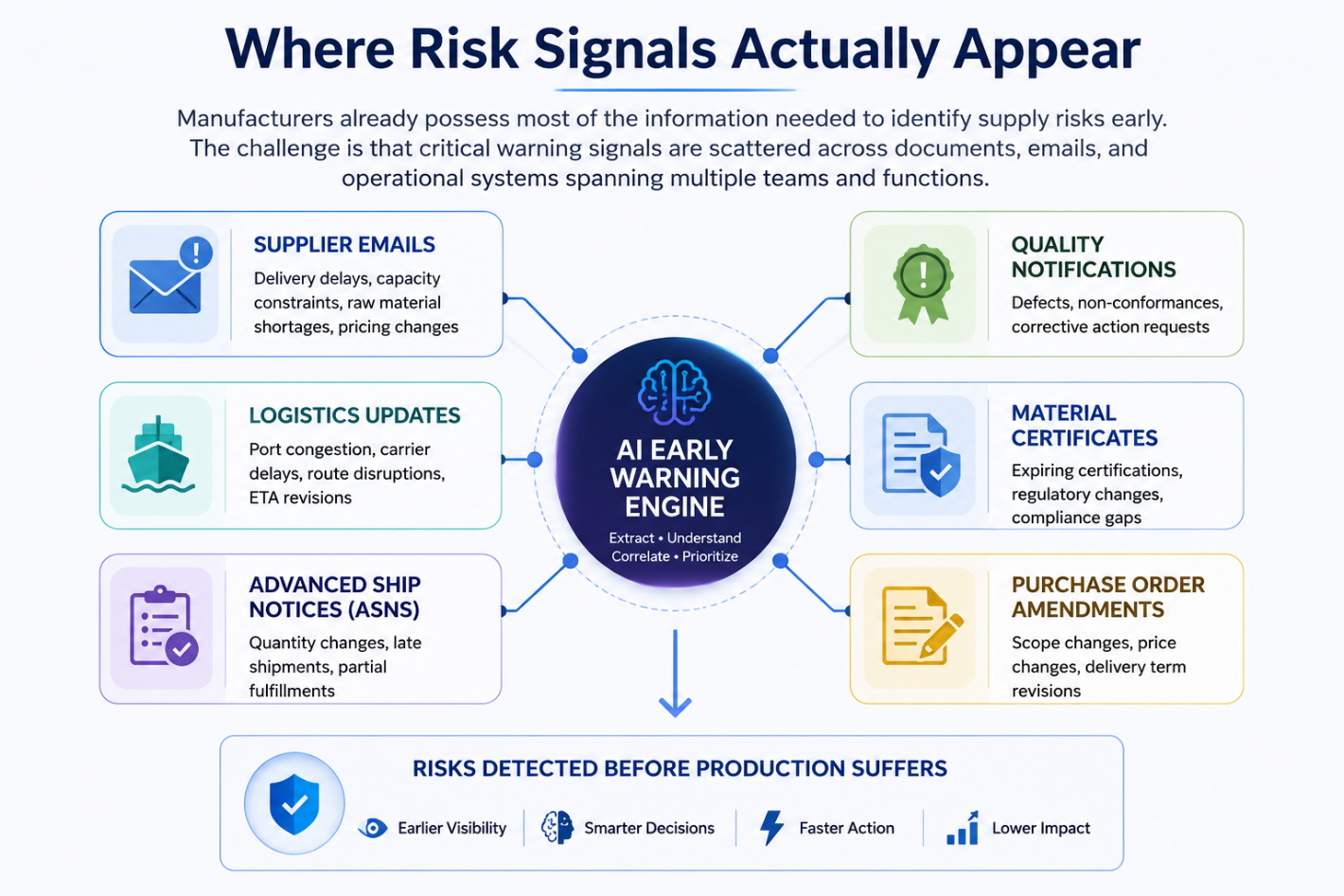
The information already exists. The question is whether it’s being read quickly enough — and whether it’s being connected to the operational context needed to understand its impact.
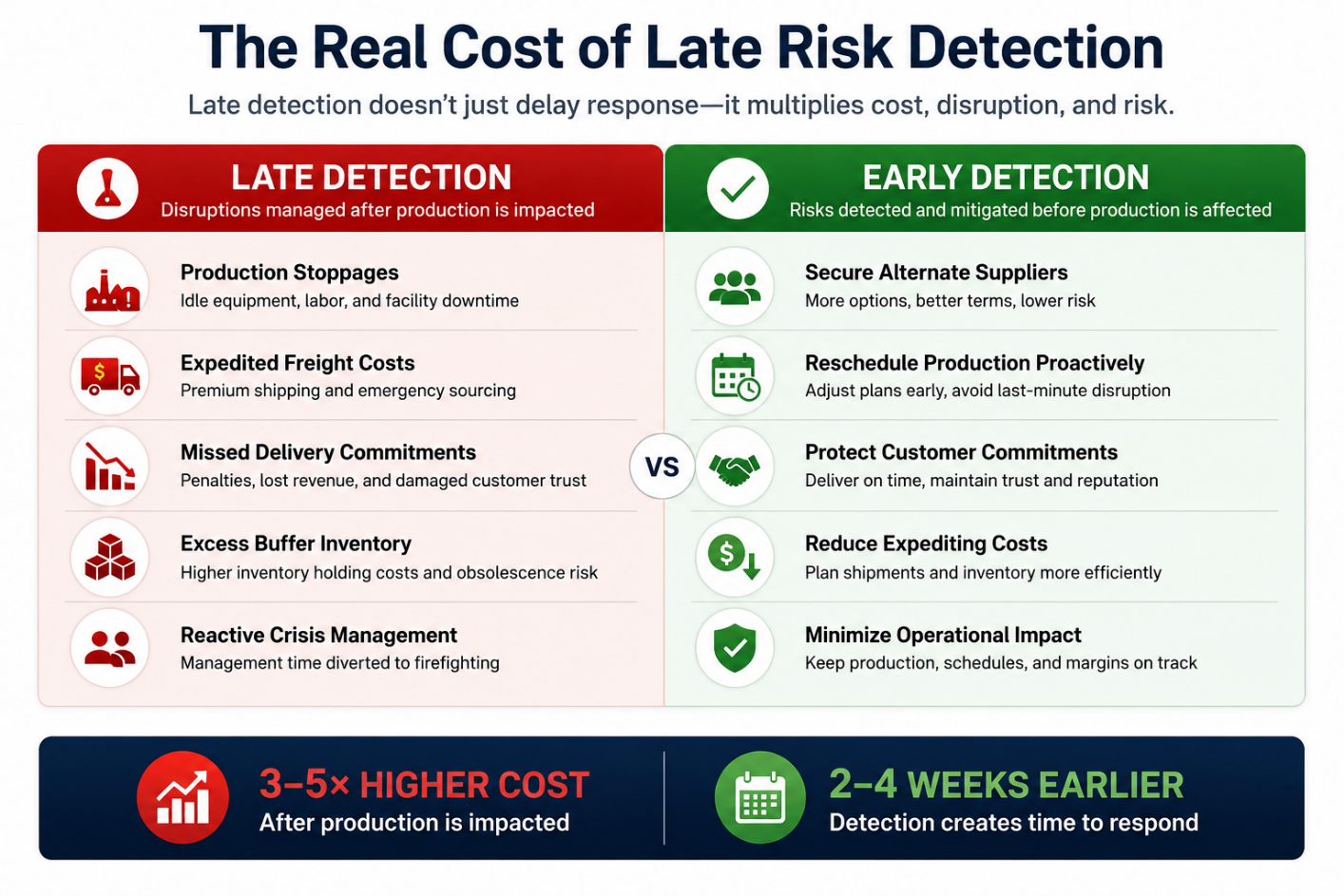
Late risk detection isn’t just an operational inconvenience. It has a compounding financial and commercial impact that most organizations underestimate because the costs are distributed across functions.
When a supply disruption is caught too late, the consequences typically include:
- Production stoppages that idle labor and equipment
- Emergency sourcing premiums and expedited freight costs
- Missed customer delivery commitments and resulting penalties
- Unplanned inventory builds to buffer against future uncertainty
- Management time consumed by reactive crisis coordination
The cost of addressing a supply disruption after it affects production is typically several times higher than the cost of the same disruption detected and managed two to three weeks earlier.
Recent research shows that supply disruptions continue to affect manufacturers across industries, reinforcing the need for more proactive risk management and resilience strategies. McKinsey Supply Chain Risk Survey
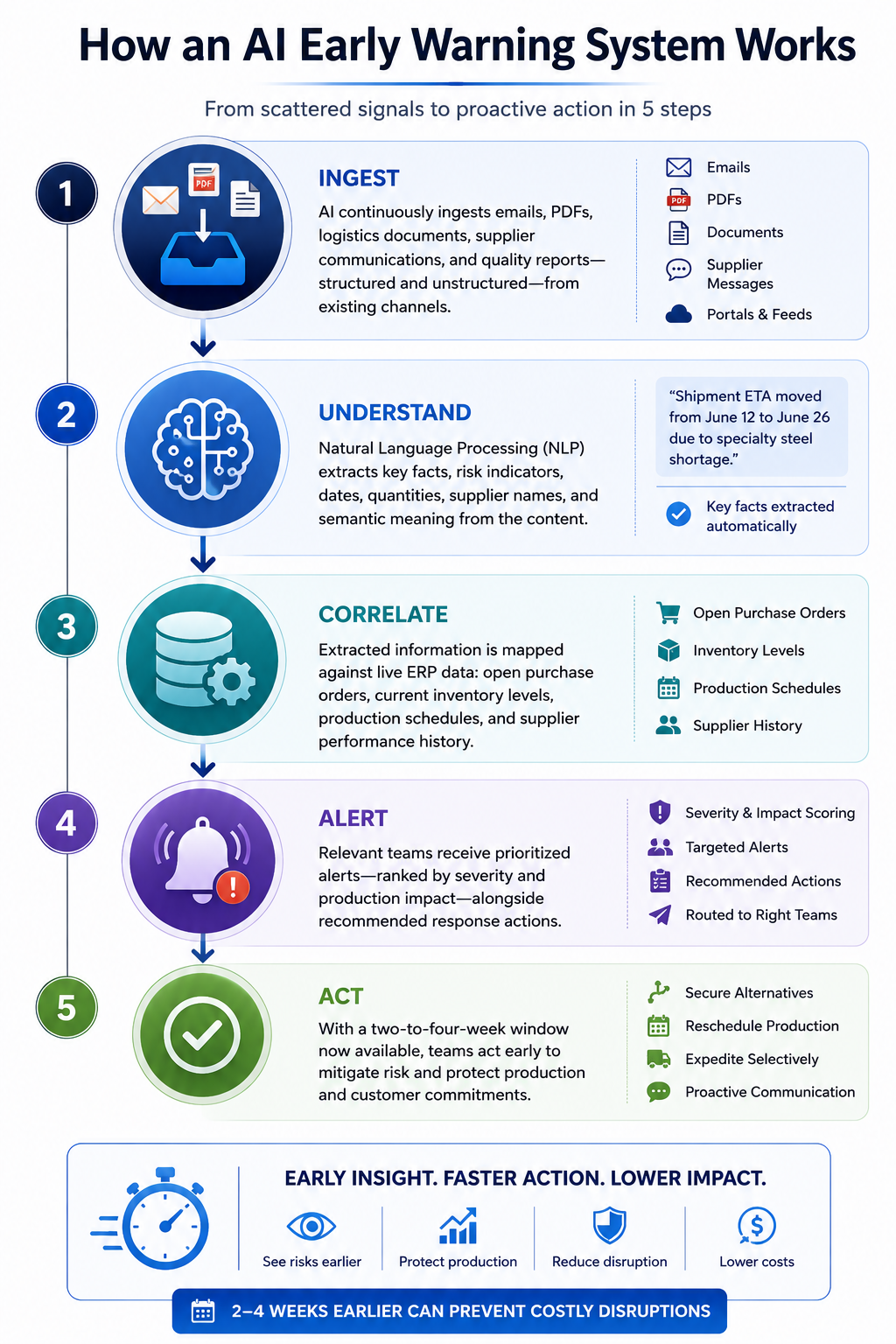
Platforms such as DocuVera360 by Trellissoft help manufacturers operationalize AI-powered early warning by continuously extracting, understanding, and correlating signals hidden within supplier communications, logistics updates, quality documents, and operational systems.
A Worked Example
Consider a supplier email that reads:
“Due to a shortage of specialty steel, shipment ETA will move from mid-June to late June.”
In a traditional environment, this message sits in a procurement inbox. It may be read the same day or several days later. Cross-referencing it with affected purchase orders, checking inventory cover, and evaluating production schedule impact requires manual effort – effort that competes with everything else happening that week.
With an AI early warning system, the same message triggers an immediate, automated sequence:
- The delay and root cause are extracted and classified
- Affected purchase orders are identified from ERP data
- Current inventory levels and production schedule dependencies are checked
- Customer delivery commitments at risk are flagged
- A prioritized alert is sent to procurement and planning with recommended actions
The response window shifts from days to hours. And critically, the alert arrives with context — not just a flag that something is wrong, but a clear picture of what is affected and what the options are.
Getting Started Without Replacing Existing Systems
A common concern among procurement and IT leaders is that implementing predictive supply chain intelligence requires significant systems work — a new platform, an ERP replacement, or a lengthy integration project.
Modern AI platforms operate as non-invasive overlays. They connect to existing systems through APIs, lightweight connectors, or RPA — and process the documents and communications teams already use every day. Common integration points include SAP, Oracle, and Microsoft Dynamics ERPs, alongside email environments like Outlook and operational data from MES and WMS systems.
This means manufacturers can begin with a single process, a specific supplier group, or one document type — and expand incrementally as value is demonstrated. There is no requirement to replace or disrupt existing infrastructure before seeing results.
Many organizations experience measurable improvements in operational visibility within weeks of deployment.
Conclusion
Supply chain risks rarely appear first as ERP exceptions. Early warning signals often emerge days or weeks earlier across supplier communications, logistics updates, and operational documents.
The manufacturers that gain a competitive advantage are those who close the gap between when a warning signal appears and when it becomes actionable intelligence. AI-powered early warning systems make that gap measurable and manageable.
As supply chains become more volatile, organizations are increasingly investing in resilience capabilities that enable earlier detection and faster response to disruption. Gartner research on supply chain resilience
This article is part of a four-part series: Four AI-Powered Capabilities Transforming Manufacturing Operations.
→ Read the pillar article for an overview of all four capabilities.
→ Next: Demand Sensing — Moving Beyond Traditional Forecasting
Ready to see how DocuVera360 can put an early warning system to work in your operations?
FAQ
- Supplier delivery delays
- Raw material shortages
- Capacity constraints
- Logistics disruptions
- Quality issues and non-conformances
- Certification expirations
- Purchase order changes
- Supplier performance deterioration
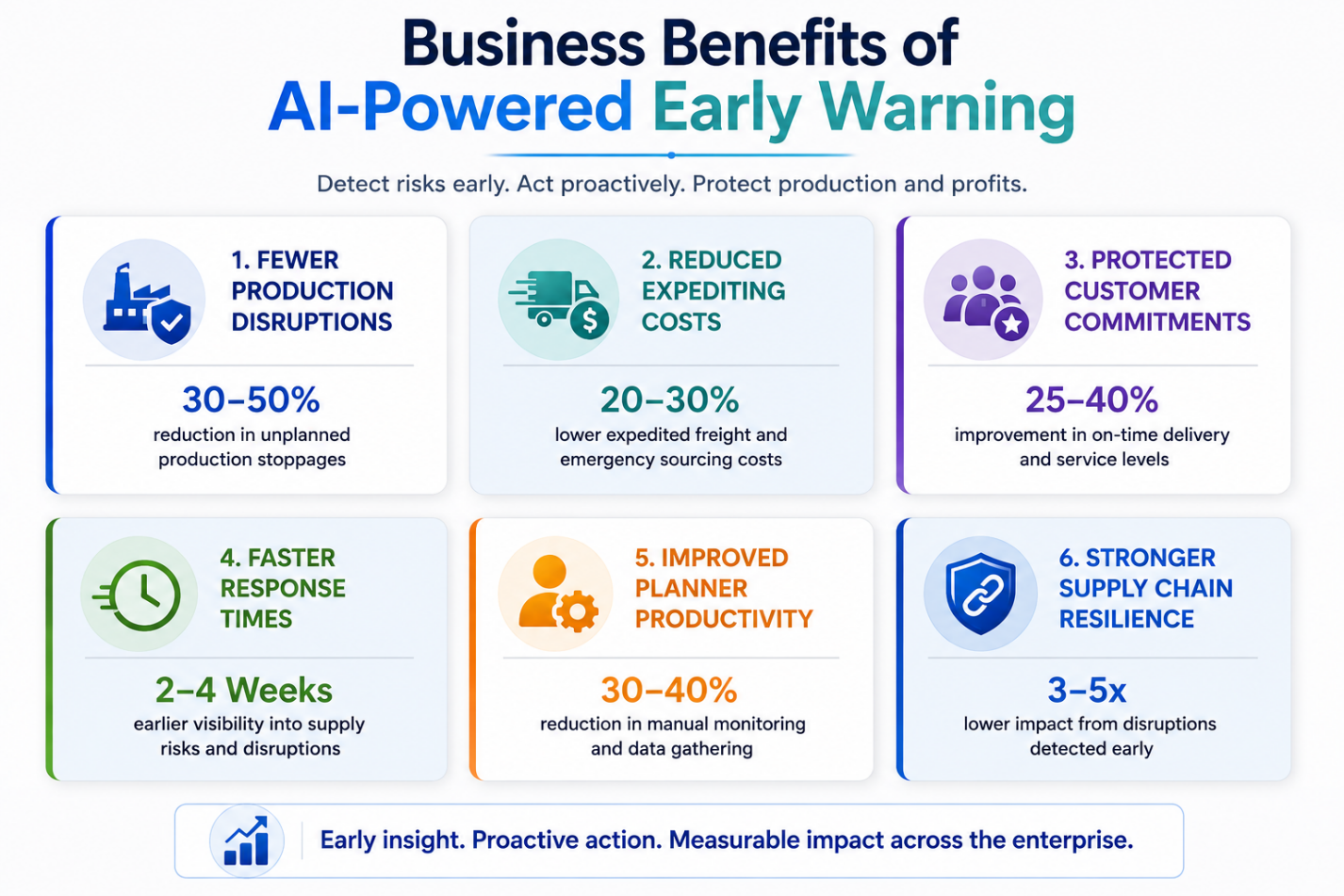
- Earlier detection of supply chain risks
- Fewer production disruptions
- Reduced expediting and emergency sourcing costs
- Improved customer service levels
- Faster response times
- Greater supply chain resilience
- Improved planner productivity