A CASE STUDY
From Paper Trail to Production Intelligence: Eliminating Manual Data Entry
Resolving Critical Visibility Gaps with Centralized Data Architecture and AI-Powered Support
Industry
Manufacturing
Domain
Data Engineering & Analytics
Executive Summary
A multi-facility precision manufacturing group runs a production environment where nearly every event — a completed work order, a passed or failed inspection, a received shipment, a line stoppage — starts life as a paper traveler, a handwritten checklist, or a photographed certificate. None of that is a paperwork problem. It is a production visibility problem: the shop floor generates the truth about what is happening in real time, but that truth reached ERP, QMS, and the people making decisions only after a human re-keyed it, hours or a shift later.
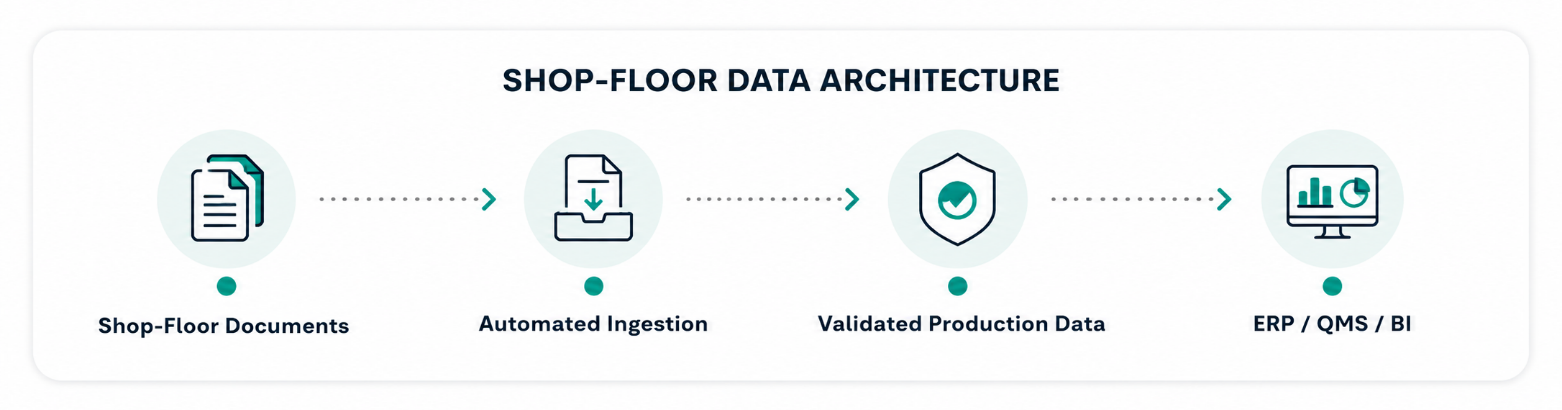
Trellissoft partnered with the organization to close that gap — not by scanning documents faster, but by turning every shop-floor document into a live, structured stream of production data. DocuVera360 became the ingestion layer of a real-time operations intelligence platform, converting paper travelers, inspection checklists, GRNs, supplier certificates, and downtime logs into validated data the moment they were created, and routing that data directly into the systems that plan, execute, and audit production.
The Challenge: WHEN THE SHOP FLOOR AND THE SYSTEM OF RECORD DON'T TALK
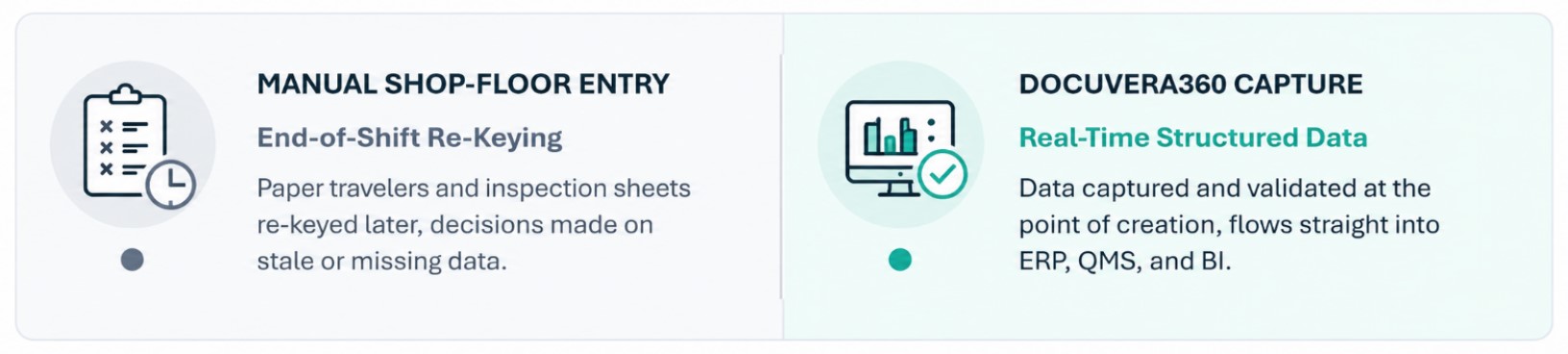
Across the group’s facilities, production runs on documents that were never designed to feed a digital system: paper travelers moving with the batch from station to station, handwritten quality inspection checklists, supplier certificates of conformance arriving as WhatsApp photos, and GRNs filled out at the receiving dock. Each one carries information the business needs immediately — but each one also requires a person to read it, interpret it, and type it into ERP, QMS, or a spreadsheet before it becomes usable data.
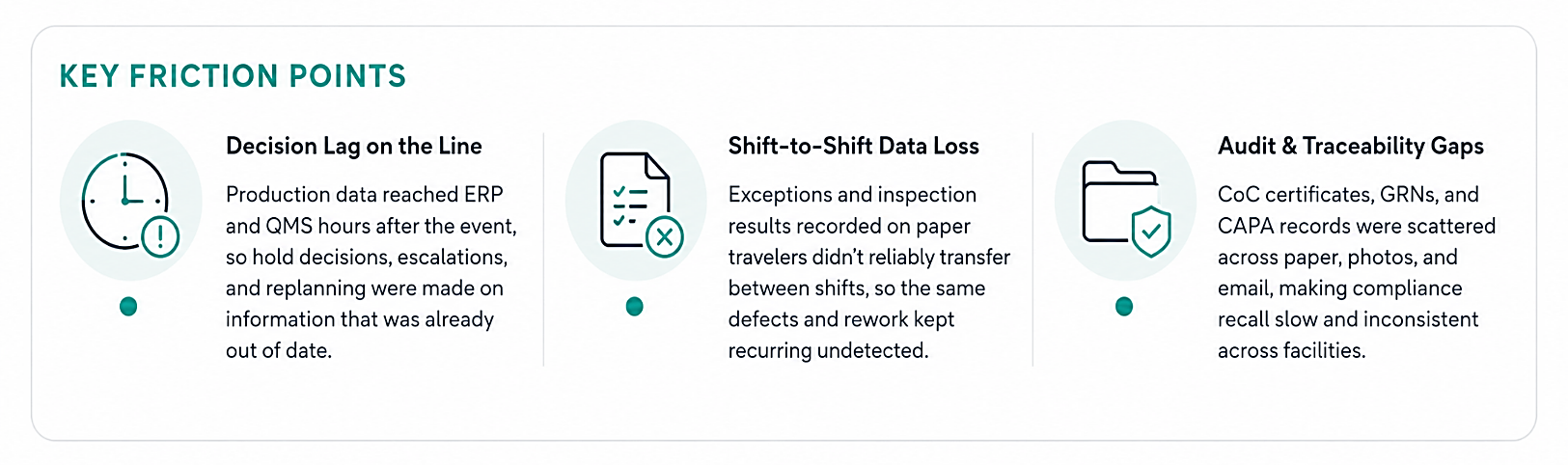
That relay step is where visibility breaks down. A defect flagged on an inspection sheet at 10am might not reach the quality system until the shift ends at 6pm. A supplier certificate photographed at the dock might sit in a phone gallery for a day before anyone enters it. By the time the data reaches a system that can act on it, the production window to act on it cheaply — hold the batch, adjust the line, escalate to the supplier — has often already closed. And because the data entry step depends on people, scaling monitoring to more lines or more facilities means scaling headcount, not just scaling insight.
THE SOLUTION: SHOP-FLOOR DOCUMENTS BECOME LIVE PRODUCTION DATA
Trellissoft engineered DocuVera360 as the connective layer between the physical shop floor and the systems that run it — not a scanning utility bolted onto existing workflows, but the mechanism that makes the floor itself a real-time data source. Key pillars of the solution include:
1
Automated Capture at the Source
DocuVera360 ingests paper travelers, inspection checklists, GRNs, and supplier certificates directly from the floor — scanned, photographed, or submitted via WhatsApp — with no dedicated data-entry step in between.
2
AI Extraction & Validation
OCR, NLP, and ML classification extract every field and validate it against BOM and spec data in real time, flagging exceptions instead of silently accepting bad data into the system of record.
3
Workflow Routing
Validated data routes automatically into ERP, QMS, and MES — hold decisions, CAPA workflows, and supervisor alerts trigger on their own, without anyone re-typing what the floor already reported.
4
Real-Time BI & Alerts
Structured production data feeds live dashboards and continuous monitoring, surfacing quality and supply trends before they cascade across shifts or facilities.
The Results
|
Metric
|
Before Integration
|
After Integration
|
|---|---|---|
|
Data Latency
|
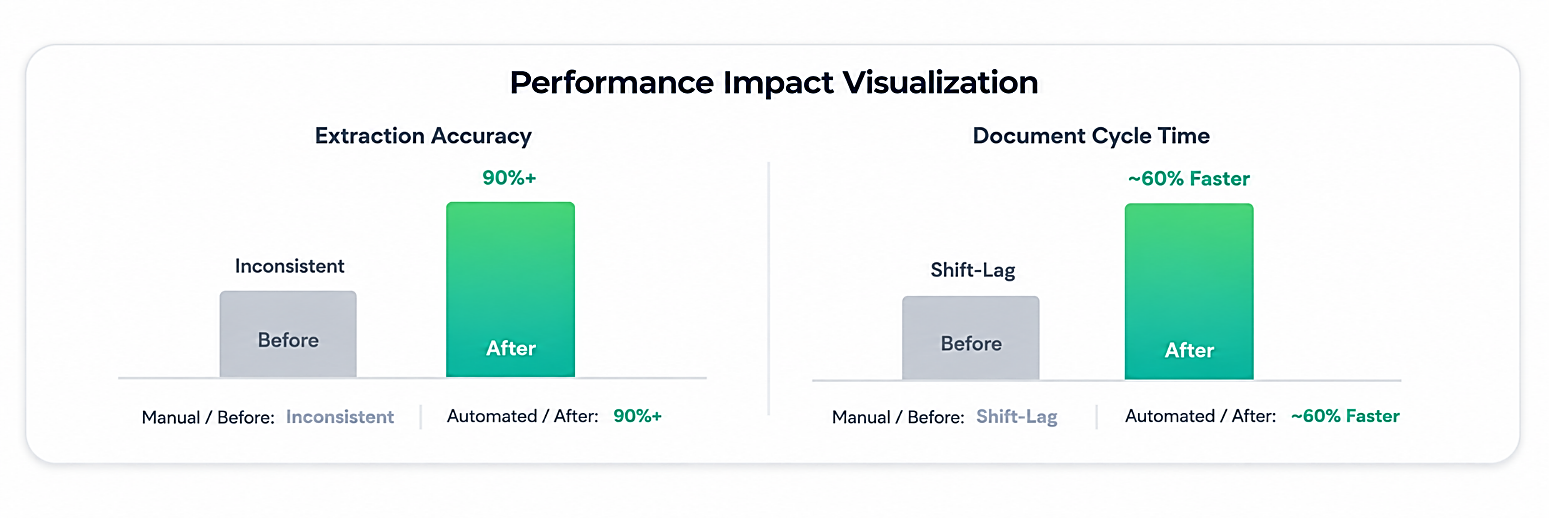
End-of-shift or next-day manual entry left production blind for hours after each event.
|
Structured data available within minutes of capture, enabling same-shift decisions.
|
|
Shift Continuity
|
Handover relied on paper notes and memory, so exceptions repeated across shifts undetected.
|
Every inspection result and exception persists in a structured, searchable record across shifts and facilities.
|
|
Processing Cost
|
Manual entry and reconciliation cost roughly $20–22 per document across GRNs, CoCs, and inspection sheets.
|
Automated capture and validation reduced cost to roughly $2–3 per document at comparable volume.
|
|
Compliance Readiness
|
CoC, GRN, and CAPA records scattered across paper, photos, and email threads.
|
Every document validated, structured, and audit-ready inside one traceable system.
|
"By capturing shop-floor documents at the moment they're created, we turned paperwork into a live feed of production truth — giving plant teams the same real-time visibility their ERP always promised, but never actually delivered."